

Warped records are a thorn in the side of any record collector. Sadly, they are also far more common than we would like—particularly, in my experience, with new records.
Whether that comes down to rushed manufacturing, insufficient cooling at the pressing plant, poor storage or careless shipping is difficult to say. Whatever the cause, it is frustrating to unwrap a brand-new record, place it on the turntable and watch the cartridge move up and down like a roller coaster.
I am even beginning to wonder whether thicker 180g records are more likely to arrive warped, rather than less.
A mild warp might be little more than an irritation, but a more serious example can introduce wow and flutter, unwanted low-frequency movement and unstable tracking. It can also place additional stress on the cartridge suspension and, in extreme cases, make the record unplayable.
Traditionally, collectors have attempted to fix warped records by placing them beneath heavy objects or between two sheets of glass for an extended period.
Some people even place the record and glass inside an oven. That is extremely risky! Domestic ovens are not designed to maintain the precise, even temperatures required for something as delicate as a vinyl groove. Apply too much heat—or apply it unevenly—and a warped but playable record can quickly become permanently damaged.
That is where purpose-built record flatteners come in.
Around a year ago, I reviewed the Pro-Ject Flatten It. Apart from its substantial price tag, I was very impressed with it. The White Bridge M2 aims to offer a more automated, refined and significantly more affordable alternative.
After testing it with several records from my own collection—including one deliberately subjected to an extreme warping experiment—I came away hugely impressed.
Disclosure: White Bridge Technology supplied the pre-production M2 reviewed here. The company had no editorial control over this review, and I do not receive any commission from Kickstarter pledges.
M2 First Impressions and Build Quality
My first impressions of the M2 were extremely positive. This thing is built like a tank!
It is exceptionally heavy and clearly very well made, but there is also a finesse to its design, finish and controls that stops it from feeling like a piece of industrial machinery.
The Pro-Ject Flatten It is similarly substantial, but it has a much more utilitarian look and feel. It is certainly not going to win many beauty contests.
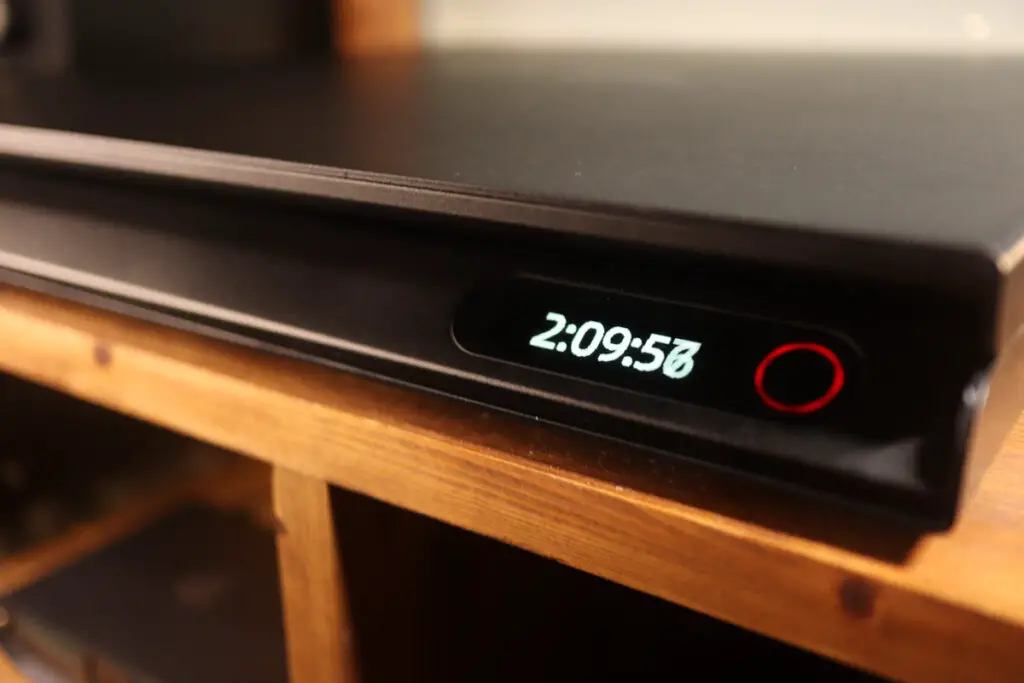
The M2 takes a very different approach. The digital display and single multifunction control feel slick and modern, particularly when compared with the chunky rocker switches on the Pro-Ject.
The best description I can give is Degritter-level luxury.
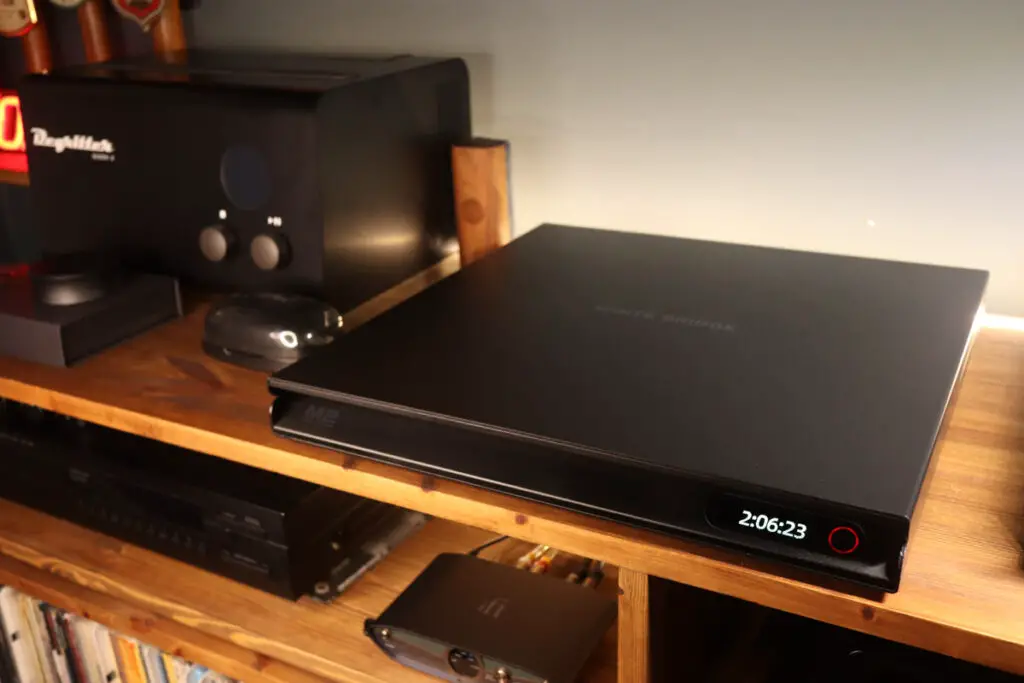
Like the Degritter record cleaning machine, the M2 feels like a specialist vinyl-care product that has been designed to sit comfortably alongside premium hi-fi equipment.
Until testing the M2, I had never really considered whether a record flattener needed to feel luxurious. But when you consider the type of customer likely to buy one—and the value of some of the records they might place inside it—why shouldn’t it?
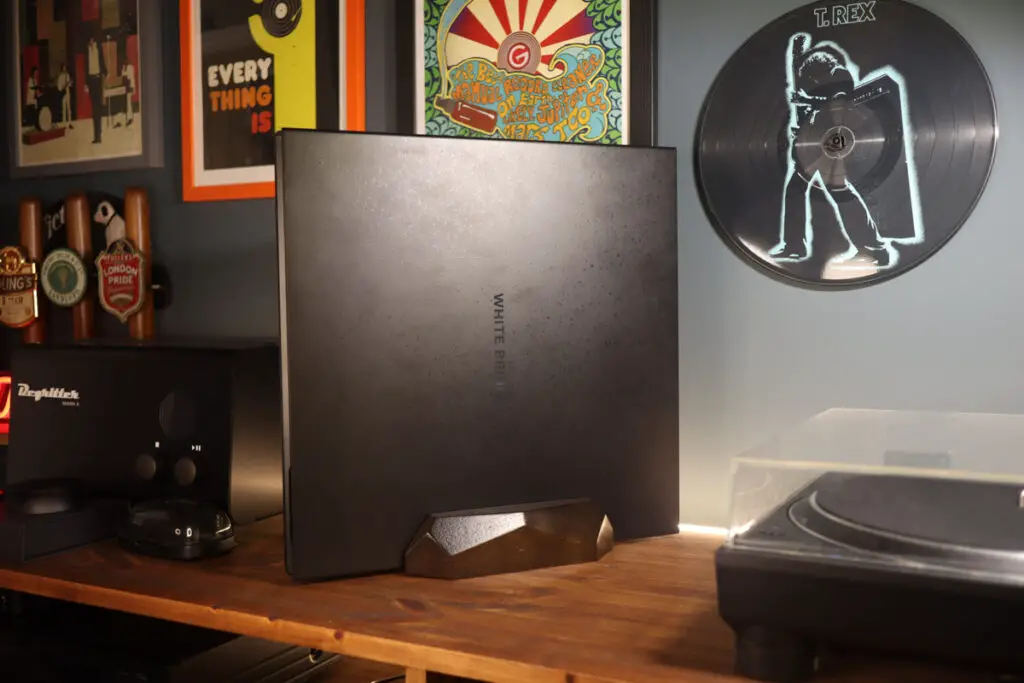
Even the storage solution is nicely considered. White Bridge supplies a wooden stand that allows the machine to be stored vertically, reducing the amount of shelf or worktop space it occupies when not in use. It looks pretty swish, too.
Why Temperature Control Matters
Record flattening is ultimately about applying the correct combination of heat, pressure and time. The vinyl needs to become warm enough for the stresses within the material to relax, but not so warm that the groove structure begins to deform.

Go too high and you could permanently damage the record.
This is one of the areas where White Bridge appears to have invested a considerable amount of time and engineering expertise. The company claims the M2 can maintain its temperature across the heated surface with an accuracy of ±0.2°C.
I did not independently measure the temperature across every part of the plate, so that remains a manufacturer claim. However, in use, the M2 certainly feels like a carefully engineered product rather than a simple heated press.
At the heart of the machine is what White Bridge calls its intelligent thermal control system. The company says this system monitors the internal temperature, ambient room conditions and thermal feedback across the surface in real time. Based on this information—and the type of record and program selected—the M2 adjusts its heating curve, holding period and cooldown rate.
That may sound like overkill, but the operating environment can vary enormously. A collector using the M2 during winter in Canada could be dealing with ambient temperatures more than 20°C cooler than someone using the same machine in Florida.
That difference can affect how quickly a record reaches the intended temperature and how rapidly it cools afterwards. In warmer conditions, the challenge is avoiding heating too quickly or holding the vinyl at an elevated temperature for longer than necessary.
In a colder room, the record may take longer to reach the required temperature, while overly rapid cooling could prevent the material from settling correctly.
The Pro-Ject Flatten It I reviewed fluctuated between approximately 56 and 58°C and required the user to switch it manually into cooling mode after the heating stage. It worked, but you had to keep track of the process yourself.
With the M2, the complete heating and cooling cycle is automated. That gives me more confidence when leaving a valuable record inside the machine and removes the risk of forgetting to start the cooling stage.

How to Use the M2 Vinyl Flattener
Using the M2 is very straightforward.
White Bridge provides a useful chart in the quick-start guide to help you select the correct program based on the weight of the record and the severity of the warp.
The available settings are:
- Light
- Medium
- Heavy
- Ultra
A light press of the control cycles through the different programs. Once you have chosen the appropriate setting, holding the button starts the cycle.
The control glows red during the heating stage before changing to blue during cooling.
When the entire process is complete, the display shows “FINISH”, at which point the record can be removed.
There is no need to set an external timer, return midway through the process or switch the machine manually into cooling mode.
You can essentially select the program and walk away.
Test One: Jeff Buckley – Grace
The first record I selected was a recently purchased copy of Jeff Buckley’s Grace.
This was a medium-weight pressing—probably around 160g—with quite a significant warp.
Based on White Bridge’s quick-start guide, I could potentially have selected the Heavy program. However, as this was my first run with the machine, I decided to begin with Medium.
After the first cycle, the improvement was immediately obvious.
The record was not completely motionless, but the warp had been reduced considerably. At this point, it was comfortably within what I would regard as playable without any further cycle required. (See embedded video above in this article for all before and after results).
This was an excellent first result and demonstrated one of the major advantages of having multiple correction modes.
I can approach the problem gradually rather than immediately subjecting the record to the most intensive treatment.
Test Two: Pink Floyd – Live at Pompeii
Next, I tried a 180g copy of Pink Floyd’s Live at Pompeii.
This record had a moderate warp, and given its weight, I selected the Heavy cycle.
Again, the result was very good.
The visible movement was substantially reduced, and there was no deterioration in playback after the flattening process–simply less wow and flutter thanks to the warp being fixed.
Test Three: Pink Floyd – The Dark Side of the Moon: Live at Wembley 1974
The most frustrating example was my copy of The Dark Side of the Moon: Live at Wembley 1974. This one arrived with a significant warp, but by the time I discovered it, I had missed the retailer’s return window.
The record was technically playable, but the movement was severe enough to make me reluctant to play it regularly.
As another 180g pressing with a substantial warp, I selected the Heavy program.
The result was excellent. This is exactly the kind of situation where a dedicated record flattener begins to make sense.
Rather than accepting an expensive record as damaged—or buying another copy—the M2 restored it to a condition where you wouldn’t even know there had been a problem.
Not every warp will respond in exactly the same way, but the results across these first three records were extremely convincing.
Putting Ultra Mode to the Test
White Bridge describes the M2’s Ultra Mode as a last resort.
The company recommends using it only when two Heavy cycles have failed to correct an especially severe warp.
That is sensible advice. When applying heat to a record, the safest approach is always to use the least aggressive treatment likely to achieve the desired result.
Multiple gentler cycles are preferable to immediately applying excessive heat and risking permanent groove damage. However, I still wanted to test Ultra Mode properly.
Naturally, I was not prepared to experiment with a valuable record, so I selected an LP that was already in poor condition and placed it outside in direct sunlight in my garden.
I left it there until the heat had warped it dramatically. The result looked more like the surface of the moon than a playable record. The record was so distorted that it was completely unplayable. I would have considered it beyond saving.
I then placed it inside the M2 and selected Ultra Mode. The machine did not return the record to perfect, factory-flat condition. But it did improve it enough to make it playable again.
Considering the intentionally extreme state of the record beforehand, that was a seriously impressive result.
This was also a useful demonstration of what Ultra Mode is really for. It is not the program to use casually on a slightly warped record. It is there for cases where the alternative may be throwing the record away.
I would still exercise extreme caution with anything rare, valuable or irreplaceable, but the experiment showed that the M2 is capable of recovering records from some fairly catastrophic warping.
Record Guards and Delicate Pressings
The M2 is supplied with several protective record guards for different sizes and types of record. Most conventional pressings do not require them. If the record has the usual raised lip around the outer edge—often referred to as a groove guard—it can be placed directly inside the machine.
This raised outer edge, combined with the raised label area, helps prevent the recorded groove surface from coming into direct contact with a flat surface. The separate guards are useful for pressings that do not have a typical groove guard, as well as delicate or especially valuable records where additional protection is desirable.
I have a valuable Beatles first pressing with a mild warp that I may eventually treat using the M2. In that situation, I would use the appropriate guards and begin with the Light program. When dealing with rare records, caution is always the best policy.
I would rather perform several gentle cycles than jump straight to a more intensive setting. No matter how sophisticated the machine, any restoration process involving heat carries some degree of risk.
Coloured Vinyl and Picture Discs
I would also proceed carefully with coloured vinyl, and in the case of picture discs, I would not place them in a flattening machine.
Different colours and compounds can behave differently when heat is applied.
This is something I have previously discussed with record pressing plants. Different vinyl colours can have slightly different melting and flow characteristics during the pressing process, and it is reasonable to assume that some of those differences may also affect how a record responds to flattening.
Conventional coloured PVC records may behave similarly to black vinyl, but unusual formulations deserve a more cautious approach.
The M2 is intended for vinyl records, so it should not be used with shellac 78s, acetates or other non-PVC materials.
Can You Flatten a Sealed Record?
One of the more unusual M2 features is its ability to flatten certain records while they remain sealed. The centre spindle can be removed, and White Bridge supplies an additional guard for this purpose.
I am not entirely convinced this is something I would personally do. If the record remains sealed, you cannot inspect the disc directly or confirm the precise nature of the warp.
However, I can see a potential use case for record shops or dealers handling valuable sealed stock. It is an interesting additional feature, even if it is unlikely to become part of my normal workflow.
White Bridge M2 Versus Pro-Ject Flatten It
The obvious comparison is with the Pro-Ject Flatten It. To be completely clear, the Pro-Ject worked. I successfully flattened several records with it and was very impressed with the results.
The M2 does not necessarily win because it produces dramatically flatter records. Both machines proved capable of correcting common warps during my testing. The difference lies in the user experience, control and automation.
With the Pro-Ject, I needed to manage the timing and manually switch the machine into cooling mode. The M2 manages the complete heat–hold–cool cycle automatically and offers several programs designed for different record weights and warp severities. That makes it easier to use and gives me greater confidence that each record is receiving an appropriate level of treatment.
The M2 is also a far more refined-looking product. Where the Pro-Ject feels like a solid piece of industrial equipment, the M2 offers that Degritter-level luxury I mentioned earlier.
Most impressively, White Bridge was aiming to bring the M2 to market for around $400 less than the Pro-Ject. Final retail pricing may change following the crowdfunding campaign, but that is a significant difference for a product that feels, in many respects, more sophisticated.
White Bridge M2 Pros and Cons
Pros
- Exceptional build quality
- Degritter-level luxury and finish
- Fully automated heating and cooling
- Light, Medium, Heavy and Ultra correction modes
- Convincing results across several records
- Ultra Mode recovered an otherwise unplayable record
- Greater control than the Pro-Ject Flatten It
- Protective guards included
- Attractive vertical storage stand
Cons
- Still an expensive and specialised product
- Extremely heavy
- Each cycle takes several hours
- Some records may need more than one cycle
- Heat-based flattening can never be entirely risk-free
- Additional caution is required with rare or unusual pressings
- Crowdfunding always carries more uncertainty than buying an established retail product
Sound Matters Verdict
I am hugely impressed with the White Bridge M2. That is not because the results were necessarily better than those I achieved with the Pro-Ject Flatten It. The Pro-Ject also worked extremely well.
What sets the M2 apart is the confidence it inspires. Its automated heating and cooling, intelligent thermal management and choice of correction modes provide a much greater sense of control. There is clearly far more going on here than two heavy plates that simply warm up and press a record flat. The M2 feels like a properly engineered restoration tool.
It is also one of the most beautifully designed pieces of vinyl-care equipment I have used. Describing it as offering Degritter-level luxury may sound excessive for a record flattener, but I genuinely think the comparison is justified.
The Ultra Mode experiment was particularly impressive. The deliberately sun-warped record was in such terrible condition that it was completely unplayable, yet the M2 managed to recover it to the point where the cartridge could track it again. That does not mean I would recommend using Ultra Mode routinely. It remains a last-resort setting for extreme cases.
Nor does it mean record flattening is completely risk-free. I would always begin cautiously with a valuable pressing and use the gentlest program likely to work.
But for serious collectors, record dealers or anyone with enough warped records to justify the investment, the M2 is a very convincing solution. Most significantly for me, it’s taken the stress out of record collecting for me just knowing that if I happen to buy a warped record, I can just deal with it right there and then. It is beautifully built, straightforward to use and, most importantly, it successfully flattened the records I placed inside it.

The replies here touch on that well. The reassurance of having every step explained matters enormously when you’re dealing with a repair that could run into the thousands. A shop that gives you a proper diagnostic breakdown tonyspins casino and clear reasoning is worth more than one that just quotes a number — because you’re less likely to end up with unnecessary work. That transparency is arguably the real “VIP” feature, not the fancy waiting room.