

I’ve tested a lot of platter mats over the years.
Felt, cork, rubber and acrylic are the obvious starting points, but I’ve also spent plenty of time with more ambitious designs from the likes of Funk Firm, Soundeck and HEXMAT, all of which attempt to deal with the relationship between the record, platter and unwanted vibration in rather different ways.
So when Stack Audio offered me the opportunity to try its SERENE Record Mat, I was initially a little apprehensive about covering yet another one. On first inspection, it looks like a fairly conventional silicone platter mat, and there are already plenty of those on the market.
Look more closely, however, and there is considerably more going on here.
Rather than relying solely on the damping properties of silicone, the SERENE uses a series of specially designed sprung supports beneath the record. Stack Audio’s intention is to isolate and absorb very small vibrations through the structure of the mat itself rather than simply attempting to damp everything with a particular material.
I’ve now had the SERENE sitting on my main Technics turntable for several months, comparing it with some of my favourite premium platter mats. And perhaps the most revealing thing I can say at the outset is that I still haven’t felt much desire to take it off.

Why Platter Mat Design Matters
At the most basic level, a platter mat provides a surface for the record to sit on. From there, designs vary dramatically depending on what the manufacturer believes should happen to unwanted vibration.
Basic rubber and cork mats tend to focus heavily on damping. Acrylic mats are sometimes intended to provide a mechanical impedance closer to vinyl itself, effectively making the record and platter behave more like a single structure. Felt, meanwhile, provides relatively little damping but is lightweight and allows DJs to slip the record against the platter.
More sophisticated designs take the problem much further.
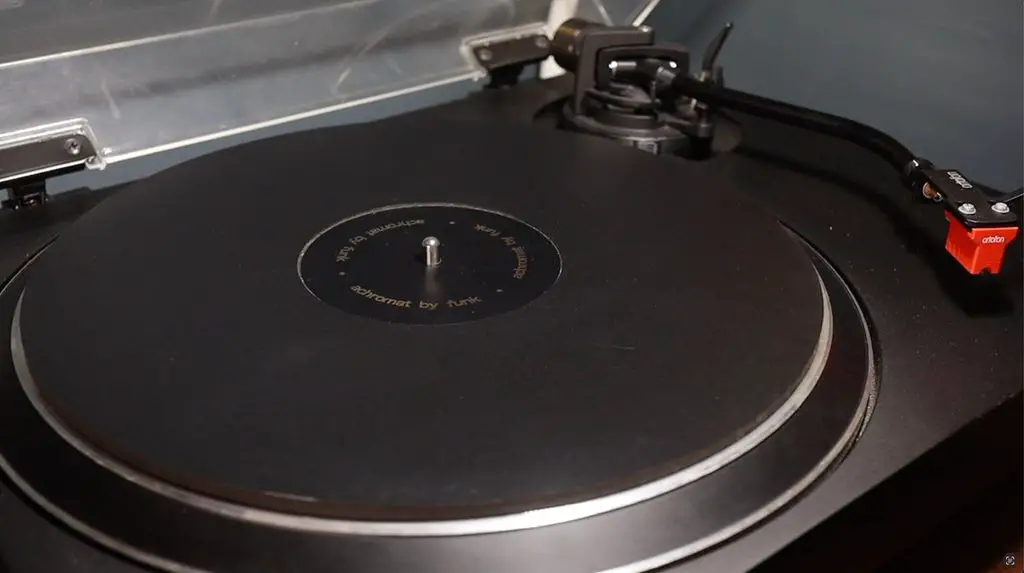
The Funk Firm Achromat, for example, attempts to couple with the record and provide vibration energy with somewhere useful to travel before dissipating it through the internal structure of the mat. My long-standing Soundeck PM295 takes another route again, using a constrained-layer metal design where two rigid layers interact with a polymer damping layer between them.
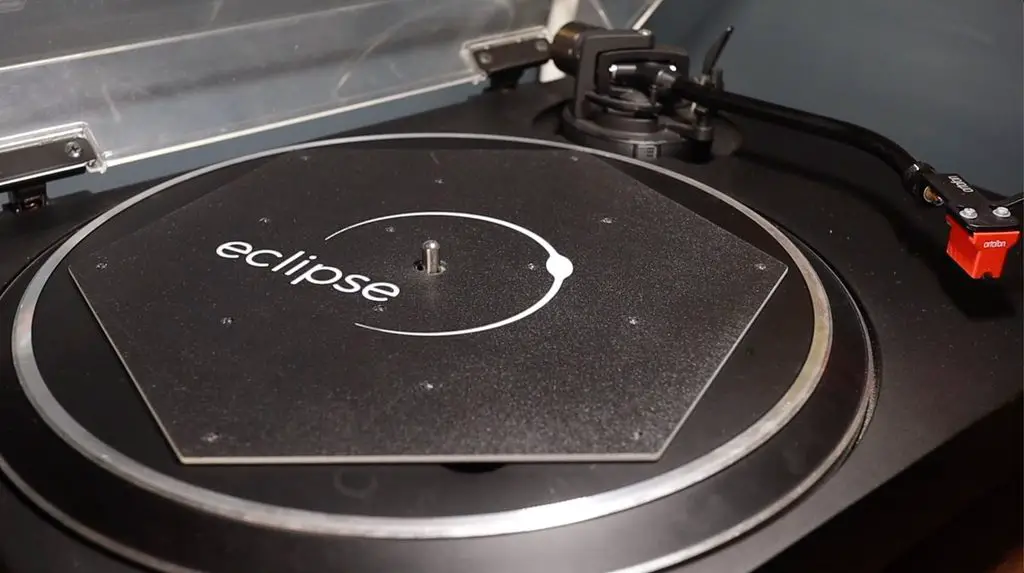
HEXMAT takes almost the opposite approach. Rather than maximising contact with the record, its designs dramatically reduce the contact area, attempting to isolate the vinyl from the platter through a small number of carefully positioned contact points.
I have enjoyed all three approaches in the right circumstances, which is precisely why I am wary of sweeping claims that one platter mat material is universally “best”.
The SERENE adds another approach to that list.
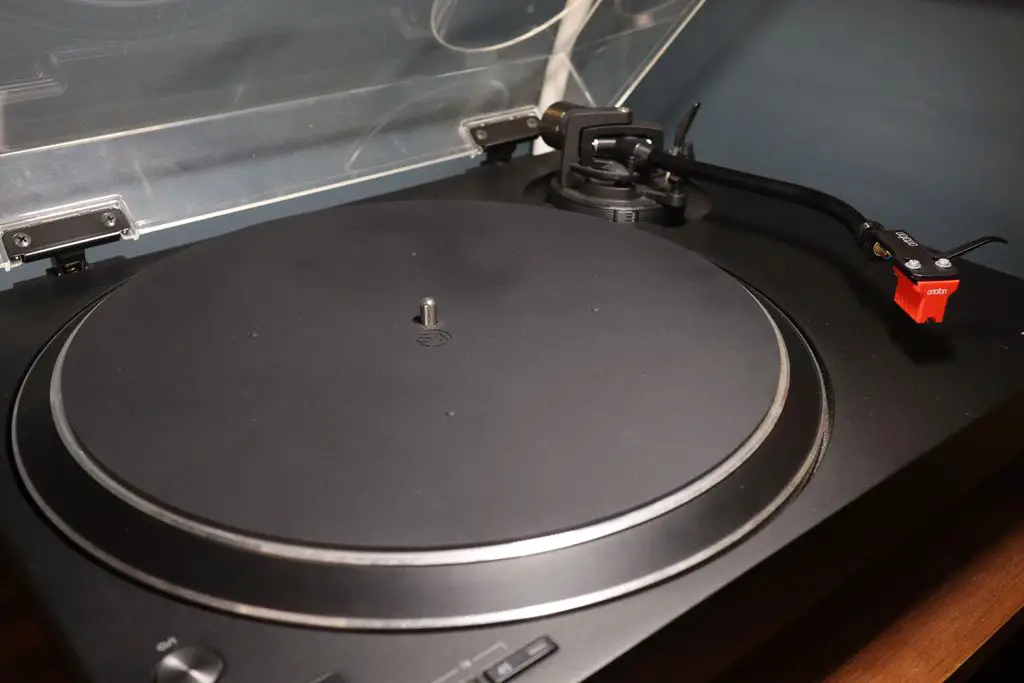
How the Stack Audio SERENE Mat Works
Stack Audio describes the SERENE as a specially formulated silicone mat containing four finely tuned sprung pads. Each pad has a raised nib that concentrates some of the record’s weight onto the spring beneath it.
The idea is that the weight of the record activates these flexible sections, allowing them to move slightly and absorb micro-vibrations before that energy can travel freely between the platter and record.
That distinction is important. Although silicone obviously has damping properties of its own, the SERENE is not simply relying on the material to absorb energy. The structure of the mat is deliberately deformable.
In other words, this belongs in the same category as products such as the Soundeck, Achromat and HEXMAT: designs that attempt to control vibration through engineering rather than simply changing from one generic mat material to another.
Stack Audio has also published measurements comparing the SERENE with more conventional mat materials across different frequencies. The company presents these as evidence that the sprung structure can absorb vibration that a normal solid mat may allow to remain in the record.
Naturally, those measurements are produced by the manufacturer, and I have not independently replicated them. I therefore treat them as supporting information rather than proof that you will hear a particular improvement in your own system.
As always with something like this, the proof of the pudding is in the eating.


Build, Fit and Practicality
The SERENE is 3mm thick and almost covers a standard 12-inch platter completely. The silicone construction gives it a slightly soft, grippy feel, but it does not behave like a floppy lightweight mat once it is sitting on the turntable.
This is one area where I immediately preferred it to some of the alternatives I own.
Both my Soundeck and Funk Firm Achromat can move relatively easily on a smooth platter. I have previously used small discrete pieces of double-sided adhesive underneath them to prevent any possibility of the mat slipping during playback.
The SERENE on the other hand grips the platter and the record extremely well.
That is desirable because any physical slipping between the platter, mat and record can only introduce another potential source of wow and flutter.
The full-diameter appearance is another positive for me personally. HEXMAT’s much smaller contact-area designs are intentional and make sense from an isolation perspective, but on the exposed aluminium platter of my Technics, I simply do not like the way they look. On the acrylic platter of my Pro-Ject X1, that aesthetic works far better.
The SERENE gives me some of that suspended-record thinking while still covering the whole Technics platter.
There is one downside to silicone: dust.
Compared with the Soundeck, which I can usually clean in seconds with a carbon-fibre record brush, the SERENE tends to hold onto fine dust rather more readily. It is hardly a serious problem, but if you are obsessive about keeping your turntable pristine, expect to clean the mat occasionally.

Listening Test
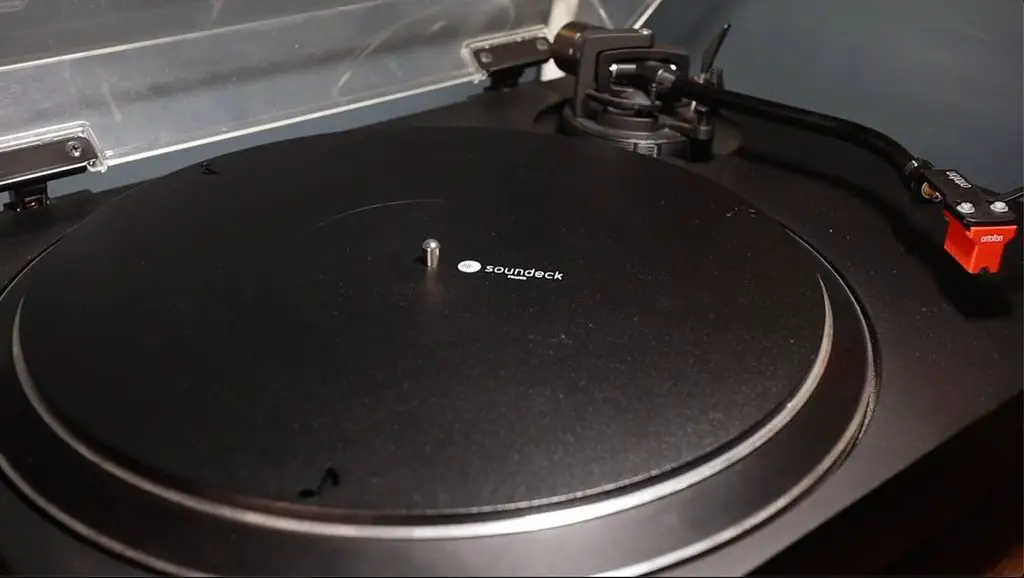
For the listening tests, I compared the SERENE directly with my Soundeck PM295, Funk Firm Achromat and HEXMAT Eclipse.
The records included Rhino’s recent reissue of Buckingham Nicks and the Tone Poet pressing of John Coltrane’s Blue Train. They gave me two very different recordings with which to listen for separation, bass control, brass, cymbal texture and the overall stability of the presentation.
The first important point is that the SERENE does not dramatically alter the tonal balance of my system.
It does not suddenly make everything brighter, larger or more overtly “hi-fi”, and I regard that as a positive.
The improvement I associate with the SERENE is primarily one of control.
Listening to Buckingham Nicks
On Buckingham Nicks, vocal and acoustic guitar parts remained clearly separated, and the overall presentation had a clean, stable quality to it. There was a pleasing sense that everything was sitting where it should rather than competing for attention.
Importantly, this did not come at the expense of body or warmth.
Some tweaks that increase the perception of detail can achieve it by making the upper frequencies more prominent, which initially sounds impressive but can become tiring. The SERENE did not give me that impression.
Instead, the sound remained balanced while gaining a composed, well-organised character.
These are subtle differences, and I would strongly resist describing them as transformational. Changing from an ordinary stock felt mat to something like the SERENE may be more obvious than moving between several already good premium mats, but this is not remotely comparable with replacing your cartridge or speakers.
That is worth keeping firmly in perspective.
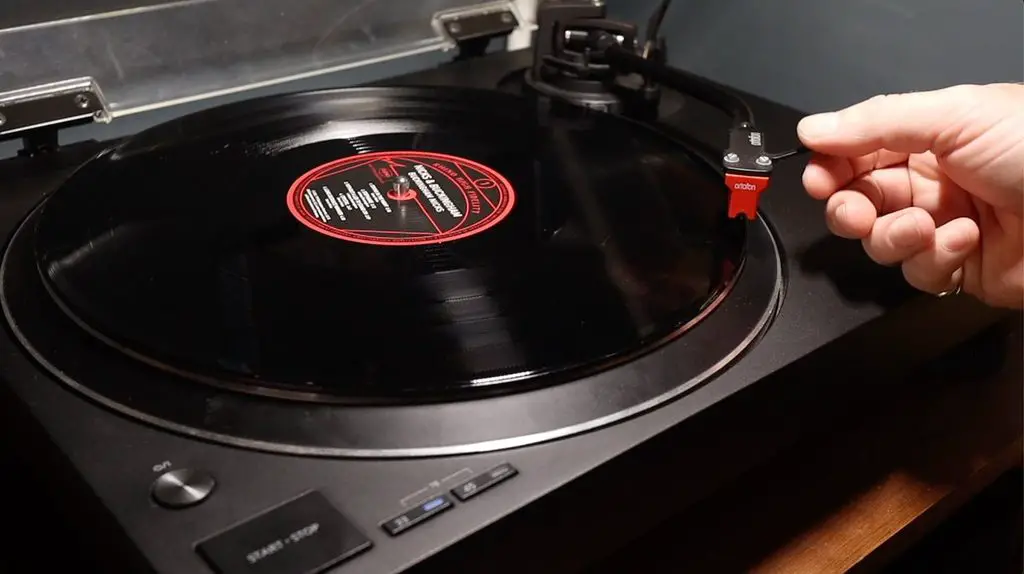
Listening to John Coltrane’s Blue Train
The Tone Poet pressing of Blue Train is particularly useful for this sort of comparison because the combination of brass, cymbals, bass and room ambience can quickly reveal when a system begins to sound congested.
Again, the SERENE performed extremely well.
Bass sounded nicely planted and easy to follow, while cymbals retained good clarity without becoming brittle or disconnected from the rest of the performance. The brass had plenty of energy, but the overall presentation remained controlled rather than becoming smeared as the arrangement became busier.
That word—controlled—kept coming back to me throughout the comparison.
The SERENE did not strip the music of life in pursuit of damping. It simply seemed to provide a stable foundation from which the record could play.

SERENE vs Soundeck PM295
The most important comparison for me is the Soundeck because that has been my go-to mat on the Technics for several years.
I still rate the Soundeck extremely highly. Its constrained-layer construction gives it a wonderfully solid, no-nonsense damping character, and it has proved to be an excellent match for my direct-drive Technics platter.
The fact that the SERENE can genuinely hold its own against it says a lot.
I would not say one comprehensively beats the other. The Soundeck retains the solidity and damping character that originally made me such a fan, while the SERENE delivers a similarly focused and stable presentation through a very different mechanical approach.
There are also practical differences. The Soundeck is rigid and extremely easy to keep clean, but it can be slippery. The SERENE is much more secure on the platter and beneath the record, although its silicone surface attracts dust more easily.
From a sonic perspective, I could happily live with either.
SERENE vs Funk Firm Achromat and HEXMAT Eclipse
Against the Achromat and HEXMAT Eclipse, I think we are firmly in the territory of system matching and personal preference rather than declaring an outright winner.
All three designs are trying to influence the mechanical relationship between the record and platter, but they approach it differently. Depending on the material of your platter, the turntable suspension, cartridge and even the resonant behaviour of the deck itself, the balance may shift.
This is one of the problems with reviewing platter mats in absolute terms. A mat that works beautifully on an aluminium direct-drive platter may produce a different result on acrylic, glass or a suspended turntable.
My HEXMAT, for example, lives very happily on my Pro-Ject X1. I simply do not enjoy it as much on the Technics, partly for aesthetic reasons and partly because I already have alternatives that work exceptionally well there.
What matters is that after several months of living with the SERENE on my Technics, I have never found myself urgently wanting to reinstall one of the others.
That tells me considerably more than any flowery audiophile language ever could.
Does the 3mm Thickness Affect VTA?
One practical consideration is the SERENE’s 3mm thickness.
If your existing platter mat is also approximately 3mm thick, there may be very little to worry about. If you are replacing something significantly thinner or thicker, however, the change alters the height of the record relative to the tonearm.
That changes the Vertical Tracking Angle, or VTA.
Whether this matters in practice depends on your turntable and cartridge. Some tonearms provide easy height adjustment, while others require spacers or offer no simple method of adjustment at all.
My Technics allows tonearm height to be adjusted relatively easily, so accommodating a different mat is straightforward. On a turntable with fixed arm height, it is something I would consider before purchasing.
You do not necessarily need to obsess over fractions of a millimetre, but changing mat thickness substantially while ignoring the tonearm geometry can undermine the very improvement you were hoping to achieve.
Record Weights and Clamps: One Important Caveat
The other major compatibility issue concerns record clamps.
Stack Audio specifically advises against using the SERENE with screw-down clamps because the additional pressure can compress the raised supports and interfere with the sprung mechanism.
Conventional non-screw record weights are officially supported up to 500g.
Even so, I am slightly cautious about placing a very heavy weight on top of a mat whose entire concept depends on carefully tuned spring movement. Stack Audio says the combination is compatible, but personally, if my goal were to preserve the intended behaviour of the mat, I would be inclined either to use it alone or with a lightweight stabiliser.
That brings us neatly to Stack Audio’s own SERENE Stabiliser.
SERENE Mat with the SERENE Stabiliser
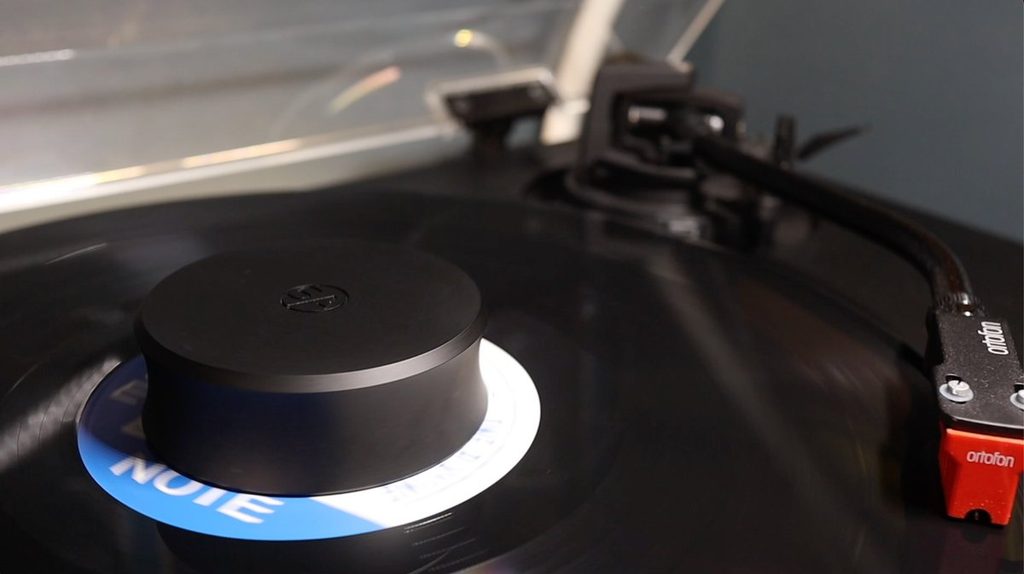
I have also spent the last few months using the SERENE Mat with Stack Audio’s matching record stabiliser.
Unlike a conventional record weight, the Stabiliser does not primarily rely on mass to control the record. Stack Audio uses a combination of a tensioned silicone membrane and internal particle damping, with the intention of absorbing unwanted vibration without placing hundreds of grams of additional weight on the record, bearing and motor.
The standard version weighs only around 85g, making it dramatically lighter than many traditional record pucks.
I may cover the Stabiliser separately because it deserves a proper comparison with the conventional weights and clamps I already own. For the purposes of this review, though, I have enjoyed using the two products together.
More importantly, the lightweight approach simply makes intuitive sense alongside the SERENE Mat. If the mat has been designed to suspend the record on carefully tuned flexible structures, it feels slightly counterproductive to me to then place an enormous lump of metal on top.
That is not to say a conventional weight cannot work—the manufacturer explicitly supports them within its stated limit—but if I were buying the SERENE as a complete system, the matching Stabiliser is the route I would personally take.
Is an Expensive Platter Mat Really Worth It?
This is where some perspective is needed.
A platter mat should not be the first upgrade you make to a turntable that is fundamentally poorly set up. If cartridge alignment is wrong, tracking force is miles out, your records are filthy or the speakers are positioned badly, spending money on an audiophile mat is not the solution.
Get the fundamentals right first.
Once those basics are sorted, however, the mechanical interface between the record and platter becomes a perfectly legitimate area to explore. A stylus is attempting to trace groove modulations measured on an incredibly small scale, so controlling unnecessary movement and vibration around that process makes physical sense.
The question is how much you should spend pursuing comparatively small improvements.
At £75, the SERENE sits well above a basic felt, cork or rubber mat, but within the specialist end of the market it is comparatively sensible. The Soundeck currently sells for around £97.50 through one UK retailer, while some premium isolation-based alternatives can cost several times more. The HEXMAT, for example, is the most expensive I own at over 300 Euros.
That puts the SERENE in an interesting position. It offers a genuinely unusual piece of engineering without immediately entering the kind of price territory where recommending a platter mat becomes increasingly difficult to justify.
Stack Audio SERENE Mat Pros and Cons
Pros
- Genuinely innovative sprung-pad design
- Excellent grip between platter, mat and record
- Clean, stable and controlled presentation
- Does not noticeably exaggerate the tonal balance
- Holds its own against some considerably more expensive mats
- Full-diameter design looks excellent on metal platters
- 3mm thickness should suit many turntables
- Works with 7-inch, 10-inch and 12-inch records
- Sensibly priced by premium platter-mat standards
- Can be paired with Stack Audio’s lightweight SERENE Stabiliser
Cons
- Considerably more expensive than a basic platter mat
- Silicone is a little trickier to clean dust off than some rigid alternatives
- The 3mm thickness may require VTA adjustment
- Not compatible with screw-down record clamps
Sound Matters Verdict
Stack Audio has done a very good job with the SERENE.
What I appreciate most is that this is not simply another mat made from one of the usual materials accompanied by vague claims about “improved warmth” or “greater detail”. There is a clear mechanical concept behind the product, and the sprung-pad design gives the SERENE a genuine reason to exist.
More importantly, it performs.
On my Technics, the SERENE delivers the kind of focused, controlled and stable presentation that I have come to expect from the best platter mats I own. It does not dramatically reshape the sound of the system, nor should it. Instead, music feels composed and well organised, with bass nicely planted, good separation and plenty of clarity without tipping into an overly analytical presentation.
The comparison with my Soundeck PM295 is particularly telling. That mat has remained on my Technics for years because I like what it does, yet after several months with the SERENE installed, I am now genuinely torn about which one stays there.
There are caveats. Check whether the 3mm thickness will affect your tonearm geometry, forget about using a screw-down clamp, and consider carefully whether a very heavy record weight makes sense alongside a mat based around sprung supports.
The silicone surface also takes a little more effort to keep dust-free than my Soundeck.
None of those issues changes my overall conclusion.
At £75, the SERENE is not cheap compared with a simple cork or rubber mat, but compared with the increasingly expensive world of specialist audiophile platter mats, I think it represents good value. It gives you proper engineering, a genuinely different approach to vibration control and excellent practical performance without drifting into silly-money territory.
Will it transform a poor turntable setup? Absolutely not.
Get your cartridge alignment, tracking force, record cleaning, VTA and speaker positioning right before worrying about this sort of upgrade.
But once the fundamentals are sorted, the Stack Audio SERENE is one of the more convincing premium platter mats I have reviewed. For me, this is an easy recommendation.
VIEW THE STACK AUDIO SERENE RECORD MAT

An unusually honest review. The key point is that the improvement is one of control rather than a change in tonal balance, and the reviewer is clear that the differences are subtle. The caveats about VTA and screw-down clamps are genuinely useful. More at https://afk-spins1.co.cz
I think the author is right that a mat really has to be judged in the context of the whole setup – the turntable, platter, tonearm and cartridge. I’d be curious to hear from Technics, Pro-Ject or Rega owners to see if they’ve had similar results with the SERENE.