
New mid-year figures show CD sales growing far faster than vinyl, while approximately half of younger CD buyers do not even own a CD player. Could this be the start of a revived format war, or simply a broader change in how people value physical music.
For the best part of two decades, whenever we have spoken about the return of physical music, we have usually meant one thing: vinyl.
Records became the unlikely success story of the streaming era, recovering from near-obsolescence to become a substantial part of the modern music business. New pressing plants opened, supermarkets began stocking LPs again and artists, once again, began treating the vinyl edition as an important part of an album campaign.
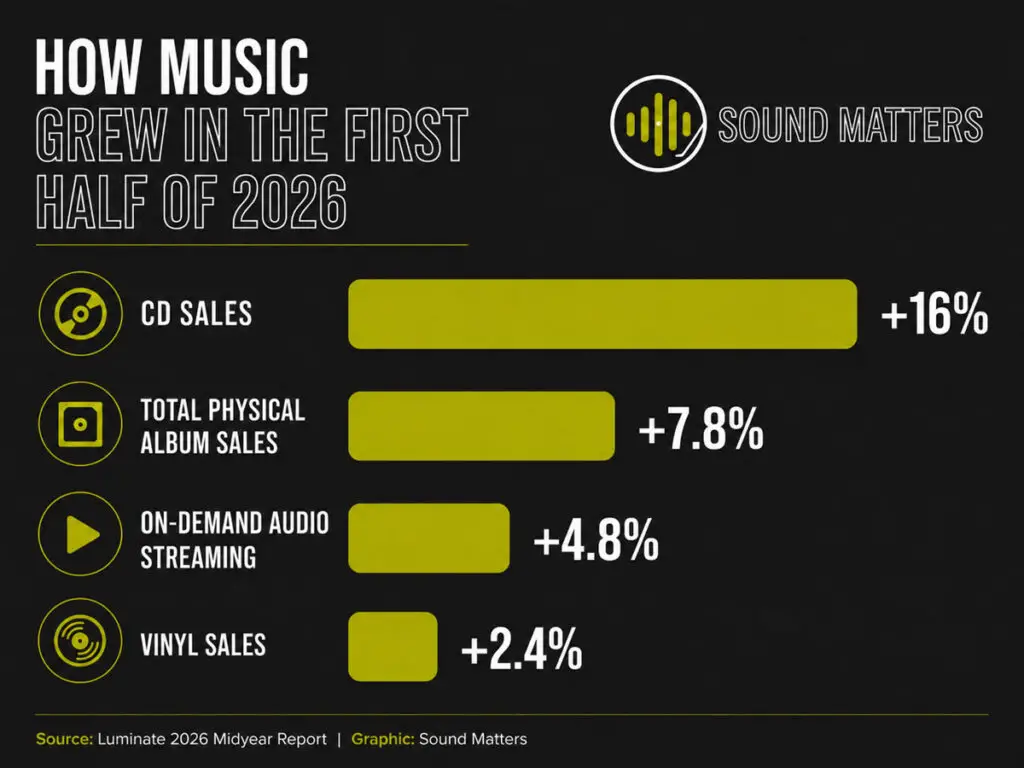
Vinyl is still very much alive and well, but the latest figures suggest the story is becoming more complicated. According to Luminate’s 2026 Midyear Report, U.S. CD sales rose by 16% during the first half of the year, reaching 16.3 million units. Vinyl sales, by comparison, grew by a much more modest 2.4%. Across records, CDs and cassettes combined, total U.S. physical album sales increased by 7.8%, from 35.5 million to 38.2 million units.
On the surface, that sounds like a CD revival and perhaps the first signs of vinyl running out of steam. But I think both of those conclusions are a little too simplistic.
The more interesting story is that physical music is changing. It is no longer driven by one format, one generation or even necessarily the desire to play the product that has been purchased. Increasingly, physical music is more than just an audio format; it’s a collectable, a piece of merchandise and even a symbol of someone’s relationship with the artist. That shift could prove more significant than any short-term competition between CDs and records.
Physical Music Is Growing Alongside Streaming
It is worth beginning with the wider context, because physical media is not rising as a result of people abandoning streaming. Luminate reports that U.S. on-demand audio streams increased by 4.8% during the first half of 2026, reaching 732.7 billion. Physical album sales rose faster, at 7.8%, but both forms of consumption grew at the same time.
This matters because it challenges the idea that music listeners are choosing between access and ownership. Most of us no longer do. Streaming is extraordinarily useful for discovering music, trying an album before buying it and having a vast library available wherever we go. Physical media serves a different purpose: we buy selected albums because we want to own them, display them, read the sleeve notes, support the artist or make the music feel like something more permanent than rented music via a subscription service.
That has always been part of the appeal of vinyl, but the Luminate report suggests the same behaviour is now spreading more noticeably to CDs.
CDs Are Rising, but K-pop Is Only Part of the Story
There is no question that K-pop is having an enormous influence on CD sales. According to the rankings in Luminate’s report, BTS’ ARIRANG was the biggest-selling CD album in the U.S. during the first half of 2026, shifting 567,000 copies. In fact, the first seven titles on Luminate’s Top 10 CD Albums list were all K-pop releases, including albums by ENHYPEN, ATEEZ, CORTIS, Stray Kids and TOMORROW X TOGETHER.
K-pop fans have become particularly effective at turning physical releases into desirable collectables. Albums are often available in multiple editions and may include photo cards, books, posters and other items designed to reward ownership. The disc is still part of the package, but it is not necessarily the only—or even the main—reason some fans buy it.
Luminate’s retail data also shows that mass-market retailers such as Target and Walmart increased their share of U.S. physical album sales from 23.3% in the first half of 2025 to 28.7% in 2026. BTS, ENHYPEN and ATEEZ were the three leading physical sellers through this channel, reflecting the strength of highly collectable releases aimed at committed fan communities. It would therefore be easy to dismiss the CD increase as a K-pop-driven anomaly, but Luminate calculates that U.S. CD sales would still have risen by 6.7% without BTS and the wider K-pop catalogue.

That is a much smaller increase than 16%, of course, but it is still meaningful. K-pop is accelerating the trend rather than creating it single-handedly.
“The line between an album and artist merchandise is becoming increasingly blurred.”
Half of Younger CD Buyers Do Not Own a CD Player
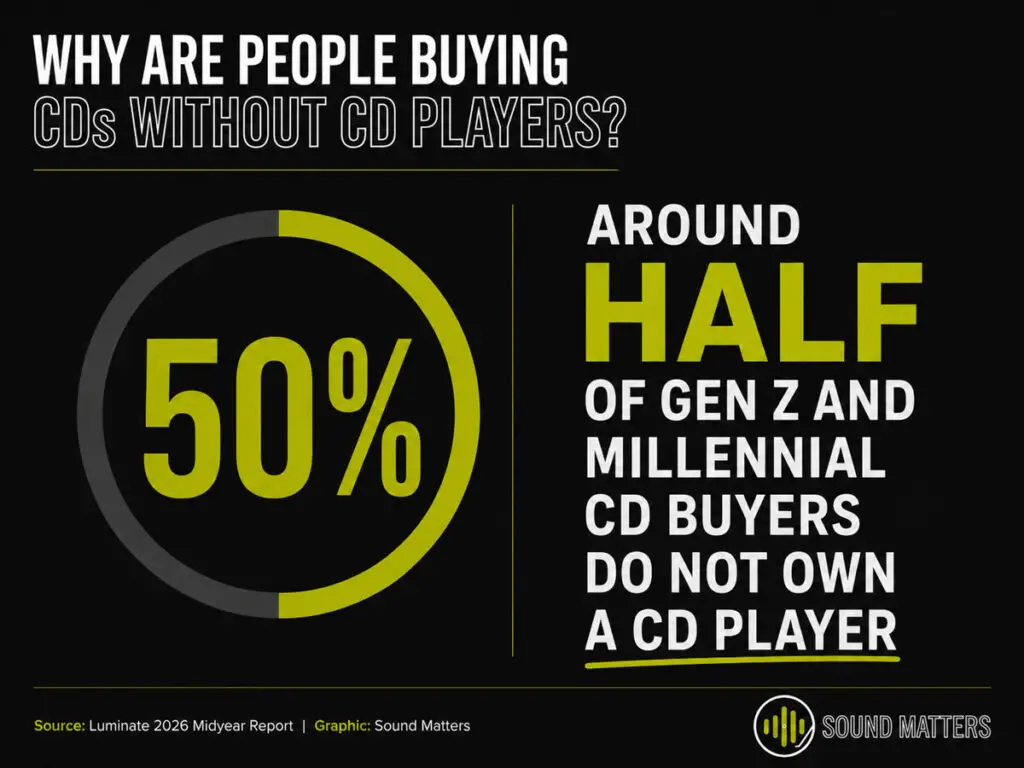
The most striking finding in the entire report may be that approximately half of Gen Z and Millennial consumers who have purchased a CD do not own a CD player, according to Luminate’s U.S. Music 360 research. At first glance, that sounds completely absurd: why buy a music format you cannot play?
We heard a similar criticism during the vinyl revival, when surveys suggested that some record buyers did not own a turntable. For traditional collectors, the idea can be difficult to understand. Surely the whole purpose of buying an album is to listen to it? But quite clearly, younger generations simply don’t see it this way.
A younger fan may stream the album while buying a CD as a collectable object, a piece of artwork or a direct way to support the artist. The purchase may represent membership of a fan community just as much as it represents ownership of the recording.
The CD is particularly well suited to this role. It is compact, relatively inexpensive to manufacture and usually far cheaper to buy than a new record. It can also accommodate elaborate booklets, alternative artwork, collectable inserts and multiple editions without reaching the increasingly high prices attached to vinyl.

From this perspective, buying a CD without owning a player is not necessarily as irrational as it first appears. The music is consumed digitally, while the physical edition provides the emotional and tangible connection that streaming cannot. The line between an album and artist merchandise is becoming increasingly blurred.
What I would be really interested to learn, is what percentage of these CD buyers aspire to eventually own a CD player sometime in the future, and how many are happy for their purchases to remain collectables.
“Old technology does not remain boring forever. Leave it long enough, and it becomes novel again.”
The CD Has Become an Affordable Collectable
As briefly touched on, price cannot be ignored here. New vinyl has become an increasingly considered purchase, particularly when deluxe releases and multiple editions are involved. For committed collectors, the cost quickly adds up.
CDs offer a much more accessible route into physical music. A younger fan may not be able to justify buying several new records, but CDs allow them to build a physical collection, support multiple artists or purchase more than one edition of a favourite album.
There is also a large second-hand supply. Charity shops, record stores and online marketplaces remain full of CDs that were produced in huge numbers during the format’s commercial peak. Many are still inexpensive, although prices for desirable early pressings and out-of-print editions are already beginning to rise.
Vinyl’s return was partly driven by a generation rediscovering something the mainstream had discarded. CDs are now beginning to benefit from a similar cycle. For someone who grew up with the format, a jewel case might still look completely ordinary. To a teenager or young adult raised on smartphones and subscription services, it can feel like an object from another era.
That difference in perspective is crucial. Old technology does not remain boring forever. Leave it long enough, and it becomes novel again.
I do have one question going forward though. If the current CD revival trend continues, will we see a similar trend that we saw with vinyl in rising prices as the laws of simple supply and demand start to take hold?
Nostalgia No Longer Belongs Only to People Who Remember the Past
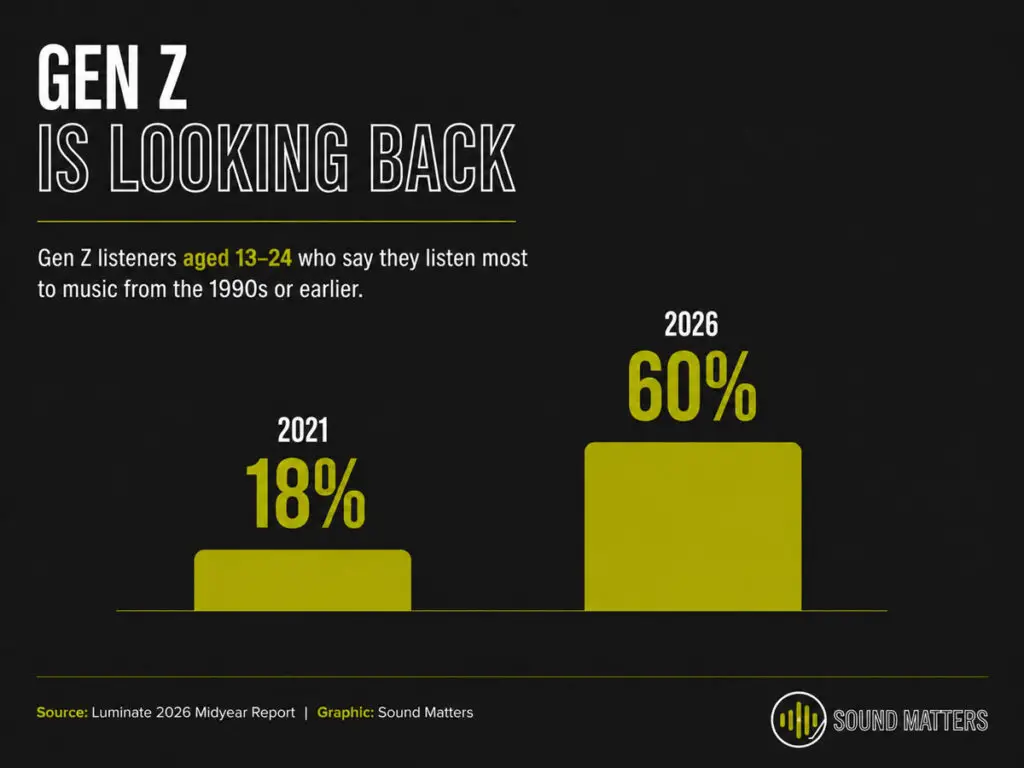
The Luminate report places nostalgia at the heart of current physical-media behaviour. Sixty percent of Gen Z consumers aged 13–24 now say they listen most to music from the 1990s or earlier. In 2021, that figure was just 18%. The report also finds that nostalgia is an important factor in vinyl purchases for 54% of Gen X and 49% of Gen Z buyers. For CDs, nostalgia influences 55% of Gen X buyers and 41% of Millennials.
The Gen Z figure is particularly interesting because much of the music in question predates them. For older listeners, nostalgia usually means returning to something personally remembered: the first album they bought, the music playing when they left school or the records their parents owned. Younger listeners can experience something different, feeling an attachment to the imagery, technology and perceived culture of a period they never actually lived through.
This is sometimes described as borrowed or inherited nostalgia. It does not rely on a direct memory so much as a romanticised idea of another era. The 1990s now exist in the same cultural space once occupied by the 1960s and 1970s: a recognisable aesthetic filled with analogue photography, music television, physical media, baggy clothing, Britpop, grunge and a world before social media became all-consuming.
Whether that version of the decade is historically accurate is almost beside the point. Nostalgia rarely presents the past exactly as it was; it selects the most attractive elements and leaves much of the inconvenience behind. The result is that physical formats can appeal to younger buyers precisely because they are less convenient. Loading a CD, handling a record or reading a booklet turns music into a deliberate activity rather than something that simply continues playing in the background.
With the growth of the internet, I would argue that it’s also questionable as to whether any of the decades following the 90s will ever enjoy the same nostalgia. The mainstream and wider adoption of the internet has arguably resulted in decades with less distinctive aesthetic and cultural identities than those of the 20th century.
What the Oasis Reunion Tells Us About Catalogue Music
The enormous response to the Oasis reunion provides a useful example of how nostalgia can become a current cultural event. Within days of the reunion announcement in August 2024, Oasis became the first act to place three albums simultaneously inside the UK Official Albums Chart Top Five. According to the Official Charts Company, their compilation Time Flies… 1994–2009 received a 332% week-on-week uplift, while (What’s the Story) Morning Glory? rose by 313% and Definitely Maybe by 297%.
That was not merely a brief spike caused by the announcement. During the reunion year itself, Oasis were the only act with three releases in the UK’s year-end Top 40 albums. Official Charts data shows that Time Flies generated 379,000 chart sales during 2025, while (What’s the Story) Morning Glory? achieved 312,000. Definitely Maybe completed the trio at number 24.
The physical impact was equally clear. Official Charts’ year-end vinyl figures show that (What’s the Story) Morning Glory? sold 55,000 vinyl copies in the UK during 2025, making it the year’s third-biggest vinyl album, while Definitely Maybe sold 30,000 and finished tenth.
Naturally, plenty of the people attending those reunion shows or buying those records were fans reliving their youth. But the scale of the event cannot be explained by middle-aged nostalgia alone. Oasis had also become part of the musical vocabulary of people who were not alive—or were extremely young—when the band first split.
A reunion, anniversary edition, documentary or viral moment can make catalogue music feel current again. The past does not simply sit in an archive waiting to be remembered; it can be repackaged, rediscovered and experienced by a new audience as though it were happening now. “Oasis Live 25” and the whole campaign which included whole pop-up merchandise shops is a perfect example of this.
Luminate’s wider streaming figures also reflect a wider appetite for older music: 75% of U.S. rock streaming during the first half of 2026 came from tracks more than five years old, up five percentage points from the same stage of 2025.
Five years is not especially old in record-collector terms, but Luminate classifies it as “deep catalogue”. The figure nevertheless shows how strongly rock consumption depends on music outside the current release cycle.
Vinyl Is Maturing, Not Collapsing
Against the CD increase, vinyl’s 2.4% growth can look underwhelming. But describing this as the end of the vinyl revival would be premature. Vinyl is growing from a much larger base than it occupied during the early stages of its comeback, and the faster a market expands, the harder it becomes to maintain the same percentage increases indefinitely.
RIAA figures for the full 2025 U.S. market show that vinyl remained comfortably ahead of CD, with 46.8 million vinyl units sold compared with 29.5 million CDs. Vinyl also generated more than three times as much revenue as the CD format.
The global picture is similarly healthy. IFPI reported that physical-format revenue increased by 8% in 2025, with vinyl revenue rising by 13.7%—its nineteenth consecutive year of growth worldwide.
In the UK, vinyl sales grew by 13.3% during 2025 to reach 7.6 million units, marking an eighteenth consecutive year of growth.
These figures do not suggest a format in immediate trouble. What they may indicate is a transition from spectacular revival to market maturity. Vinyl is no longer an unexpected novelty returning from the dead; it is now an established premium format with a sizeable audience, a developed retail network and its own predictable release calendar.
That brings new challenges. High prices, quality-control problems, excessive variants and the sheer volume of releases could all constrain future growth. A cost-of-living squeeze also makes a new record a more considered purchase than a CD. But slower growth is not the same as decline.
Rock Fans Remain Unusually Committed to Physical Ownership
Sound Matters subscribers should also take some encouragement from how heavily physical album sales continue to lean towards rock. Luminate’s format and genre data shows that rock accounted for 44.5% of U.S. physical album sales during the first half of 2026. By comparison, it represented 18.7% of on-demand audio streams.
That gap tells us something important about the culture surrounding the genre. Rock listeners are more likely to treat albums as complete works and to place value on ownership, packaging and collections. Much of the genre’s audience also grew up when physical media was the standard way to hear music, so the habit of buying albums has never disappeared completely.
At the same time, the continued success of catalogue titles suggests that younger listeners are entering that market too. Albums by Michael Jackson appeared twice in Luminate’s 2026 U.S. vinyl Top 10, while established catalogue releases continue to sit alongside current records. It’s encouraging to see that the album remains particularly resilient among listeners who value music as more than a stream of individual tracks.
Physical Ownership Is Increasingly an Expression of Fandom
Luminate separates modern superfans into two broad groups: those who demonstrate fandom through purchases and those who demonstrate it through engagement. According to Luminate’s 2026 findings, 22% of U.S. music listeners qualify as purchase-based superfans, while 17% are engagement-based. Eleven percent sit in both groups, meaning they are likely to spend money, participate in communities and actively champion the artists they follow.
This overlap helps explain why physical releases remain commercially important even when streaming dominates listening time. A fan can stream an album every day, discuss it online, attend the tour and still want a physical object representing that relationship. As touched on earlier, the record or CD becomes part of a much wider pattern of engagement.
K-pop has perfected this approach, but it is not unique to K-pop. Luminate’s genre and superfandom analysis also identifies indie rock and EDM as genres with unusually strong concentrations of purchase- and engagement-based fans.
The industry is learning that physical media works best when it offers something streaming cannot. Sometimes that is superior packaging or sound quality. Sometimes it is scarcity, collectability or access to a fan community. The most successful physical release increasingly feels like an event rather than an obligation.
As we’ve talked about many times here at Sound Matters both on the website and the YouTube channel, the physical format resurgence does clearly represent a broader desire from music fans for an experience beyond just renting music from a subscription service.
The Four Forces Shaping the Next Physical-Media Era
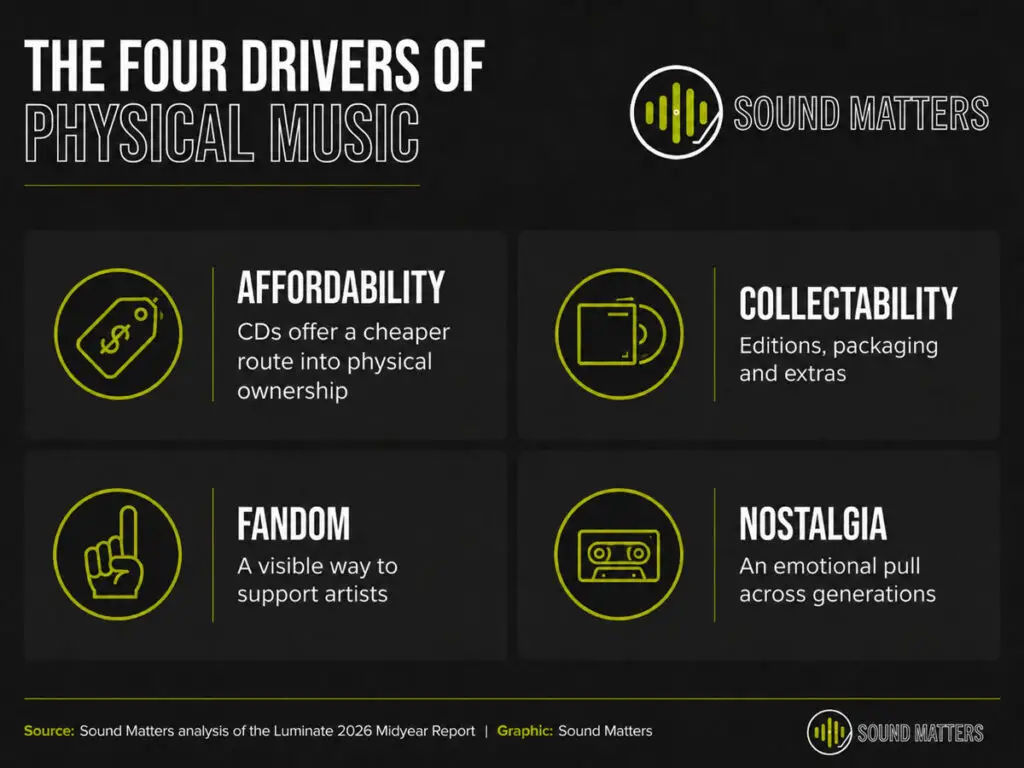
Looking across the data, I think four forces are now driving physical music.
Affordability
The high price of new vinyl creates space for CDs as a lower-cost collecting format. Consumers can buy more albums, explore artists with less financial risk and participate in physical ownership without spending premium vinyl prices.
Collectability
Multiple covers, photo cards, booklets, coloured editions and limited runs turn albums into objects worth owning independently of playback. This can be overdone, of course, but it is clearly effective.
Fandom
Buying a physical release is a visible and direct way to support an artist. For highly engaged fans, the purchase is part of a wider relationship involving streaming, live shows, social media and community participation.
Nostalgia
Older buyers are reconnecting with formats and music from their youth, while younger audiences are discovering earlier decades as something new. The emotional pull of the past now crosses generations rather than belonging to one age group.
“People are not buying less meaningfully because they stream the music elsewhere. They are simply separating the act of listening from the act of owning.”
The Physical Revival Is Becoming Bigger Than Any One Format
For years, vinyl carried the physical-media story almost by itself. It proved that convenience was not the only thing listeners valued and that people would still pay for a tangible relationship with music. The latest figures suggest that this behaviour is expanding rather than disappearing.
CDs are growing because they offer something different from vinyl: lower prices, portability, compact collectability and a direct link to fan culture. Vinyl remains the premium physical format, valued for its scale, artwork, ritual and connection to the album as a complete experience. They do not need to defeat one another.
Nor does either format need to defeat streaming. Streaming provides access; physical media provides ownership and emotional weight.
The most surprising buyers in this new market may be the people who do not own the equipment required to play what they purchase. But perhaps that tells us less about the failure of physical formats as audio carriers and more about their growing value as cultural objects. People are not buying less meaningfully because they stream the music elsewhere; they are simply separating the act of listening from the act of owning.
Vinyl may be entering a steadier, more mature stage, while the CD enjoys the excitement of being rediscovered. Beyond the short-term percentages, however, the direction is the same. Physical music is no longer one unlikely comeback story. It is becoming a permanent and increasingly diverse part of how fans experience music.
In that sense, we could truly be entering a golden era for choice and experience that non of the pundits could have predicted when peer-to-peer file sharing services first shook the music industry at the turn of the millennium.
Sources:
This article is based primarily on analysis of Luminate’s 2026 Midyear Report, covering U.S. music consumption during the first half of 2026, with additional market context from the RIAA, IFPI and the UK Official Charts Company.
Official Charts: The best-selling UK vinyl releases of 2025
Luminate 2026 Midyear Report: Trends in Music, TV & Film
Luminate: 2026 Midyear Report public findings and commentary
RIAA: 2025 U.S. recorded music year-end report
IFPI Global Music Report 2026
Official Charts: Oasis catalogue surge following the reunion announcement
Official Charts: The biggest UK albums of 2025

jcrank
I have always thought to minimize the expense associated with enjoying music and other media period in my use.Commonly , the only media available for records, radio, and magnetic tape both reels and cassettes. The vast majority of commercially produced and released media what far too expensive for me, so very early on I adopted a policy of almost never paying for music, and instead finding ways to leverage the foolishness of others who had already done so, first as an elementary-school child recording onto small reels of tape ftom AM radio, then in middle school moving up to cassettes and friends’-and-relatives’ record collections, then to the record library of my high school’s student-run radio station, then (in stereo for the first time, everything prior having been in mono) the libraries of local commercial stations where several of my friends and I got weekend part-time jobs. By the time I started college and no longer had access to these kind of resources — not even a radio, or even a car with a radio — I had over a hundred cassettes, full of music I liked, to keep me satisfied (and allow me never to hear anything I DIDN’T like). Which was just as well, since that period coincided with the early 1980s when very little pop / Top 40 music appealed to me anyway. (I was on hand in the Student Union when MTV played its first music video, but for the most part I never took time to sit and watch music videos. (I never truly understood all the fuss about Madonna, throughout the early ’80s especially, until forty-plus years later when I finally got around to watching some of her early videos. And then — holy sh**, NO WONDER.)
By the time a reasonable percentage of the Top 40 once again were good songs — call it 1984 or 5 — I was at a whole other college and once again had friends with record collections, including one who also had a lot of money that he spent freely on tons of records. I spent many hours taping many albums — and many individual tracks when an entire album only held one or two good ones — from that guy. By the time I graduated from THAT school, I had TWO hundred cassettes full of music, all of it in stereo and of much higher quality than the first hundred cassettes.
After that, it was off to adult professional employment, marriage, car and home ownership — then divorce, remarriage, and childrearing — all of which kept me in the same box as always, of not having money to buy new music.
Fortunately, somewhere in the middle there, CDs came along, and a lot of people just plain THREW OUT their vinyl record collections, en masse. Every now and then I was in the right place at the right time to take boxes and boxes of records off people’s hands, FOR FREE, just as a favor to them to clear out the space they were taking up.
When the Internet, MP3s, streaming services, and Napster — O, my beloved Napster! — can’t along, the same thing happened with CDs, though not in quite as large mass volume: mostly, techs and CDs stated turning up at garage sakes, estate sales, and flea markets, for the first time ever at prices I was wiling to pay: 25-50 cents for a 45-RPM single, $1.00 for an album or a CD. A lot of places and people still charged more than that, die the first decade or so, but I wouldn’t buy from THOSE price-gougers!
Eventually, in recent years, prices have leveled out at about the $1 mark, I’ve acquired more multi-crate vinyl collections for free again from friends’ deceased relatives’ estates, and my brother-in-law’s stepmother, now nearing 80 and aiming to downsize her home, just lay week have me six or seven CDs she was ready to part with. (It would have been twice that number, except that her husband complained that some of the discs she was giving away were HIS and he WASN’T ready to part with them. I’ll bet I get a phone call when he eventually passes, though.)
Over the years there have been a couple of records I’ve wanted badly enough that I’ve been willing to pay more than my usual dollar for them, in some cases because I saw them, DIDN’T pay the asking price, regretted it, then found them gone when I went back to buy them after all, and in other cases as a result of having to scour the entire Internet to find, say, a copy of an item I signed out of my Public Library many times during high school, and would/should have simply stolen at that time if I had known what was going to become of the library’s entire vinyl collection just a few years later when CDs came in.
The tragic truth is that cassettes too have been given terribly short shrift, the last twenty years or more. As recently as about 2012, one day while stopping by a local college on an errand on my way to work, I was shocked, horrified, and appalled to find a full- sized dumpster outside the school library, half filled with cassette tapes they’d simply thrown away. I immediately crammed as many of these as I could into my pants pockets, shirt pockets, socks, underwear, armpits, etc., and hobbled stiff-legged across campus to my car, thus managing to salvage about thirty cassettes out of what must have been several thousand in that damned dumpster. (I then spent a week drying them out, as they’d been lightly rained on overnight.) I still mourn the fact that I didn’t have the resources — bigger clothes, more/bigger pockets, more time, nearby friends, a dumpster if my own, or advance notice of the discarding — to have saved more of those tapes. Most were recordings of radio broadcasts of live performances by various Big Bands of the 1940s, precisely-and-exactly identified as to date, time, and location of the performance! What a treasure trove, to be so callously discarded! I’m sure those things were NOT being replaced by CD versions, either.
If people supposedly responsible for holding and preserving rare media can just throw it out when it suits them, I don’t feel as guilty as I might, about acquiring most of my collection for free, often by simply INTERCEPTING such indignities-in-progress. Too, I can almost guarantee that I am, if not absolutely the sole possessor, at least one of a VERY FEW possessors, of possibly a whole lot of things.
Yep, people want a physical format that they own and cannot be taken from them or lost in the cloud.
Vinyl went way up in price, which I understand, but I will only buy vinyl over CD if the vinyl was originally recorded in analog format.
‘s, aI have bought tons of CD’s over the last dozen years or so. Mostly independent artists to support them. And they usually autograph them as a bonus, Of course, I rip them as soon as I get them, and put the music on my phone to have with me at all times. But I often frame the CD’s and cases — often with my tickets to the artist’s shows and pictures that I took.
I don’t expect ever to make any $$$ with my collection of these CD’s. It’s just fun memories and knowing I helped an up-and-coming band out when they were struggling. Good enough for this old man!!!
Of course, I still have tons of records that I bought at record stores in the 1970’s, as well more CD’s than I want to admit from the BMG CD Club back in the day!!!
For me it just comes down to affordability. I love vinyl but I am now very picky when it comes to a CD or Vinyl. The majority of my physical music purchases are now CD’s due to the high cost of a new album.
CDs also play in DVD/Bluray players.
While that is true, but having a dedicated CD play makes the CDs sound better than playing through a DVD/Blu-ray.
A dedicated CD player will sound better than a DVD/Blu‑ray player because the hardware inside each machine is built for different priorities. CD players are optimized for accurate Red Book audio extraction, low‑noise analog output, and stable clocking. DVD/Blu‑ray decks are optimized for video decoding, multiformat compatibility, and cost efficiency, not high‑fidelity 44.1 kHz audio.
DVD/Blu‑ray players can play CDs, but their internal digital‑to‑analog converters are usually designed around movie playback, not music fidelity, because movie soundtracks are not as high quality as CD. Dedicated CD players typically use better DAC chips, cleaner analog output stages, and tighter clocking resulting in lower jitter and more accurate conversion.
A few listeners report no difference in the sound of a CD when being played in a Blu-Ray but they’re using soundbars, Bluetooth speakers, and low‑resolution systems, in those setups, the playback chain masks the differences. On a resolving stereo system, the gap becomes obvious. Remember, TV sound is low resolving because the movie industry is not recording their soundtracks to be high resolving.
If you don’t have a CD player and are playing your CDs in a Blu-Ray player you are missing a lot unless you’re playing through Bluetooth speakers, or soundbars, or satellite speakers, and if you are doing that then there is no need to spend money for a CD player.
My teenage granddaughter likes to peruse my CD collection whenever she comes to visit. She even took some of my cassette tapes the last time she was here. Plus, she’s into vinyl as well. She stays up to date on modern technology. She hasn’t expressed a desire to take any of my 8-track tapes yet.
I would guess that young people buy CD’s because they can afford a used car with a CD player?
LOL! Well, I do have a 2002 Lexus SC430 that came with both, a CD player and a cassette player. So now I can record my vinyl onto cassette and play them in that car. There is a push for AM radio not to be banned in new car radios; and with the resurgent of cassette I wonder if dual systems like my Lexus will start to show up at some point in the near future?
My other cars only have CD players.