
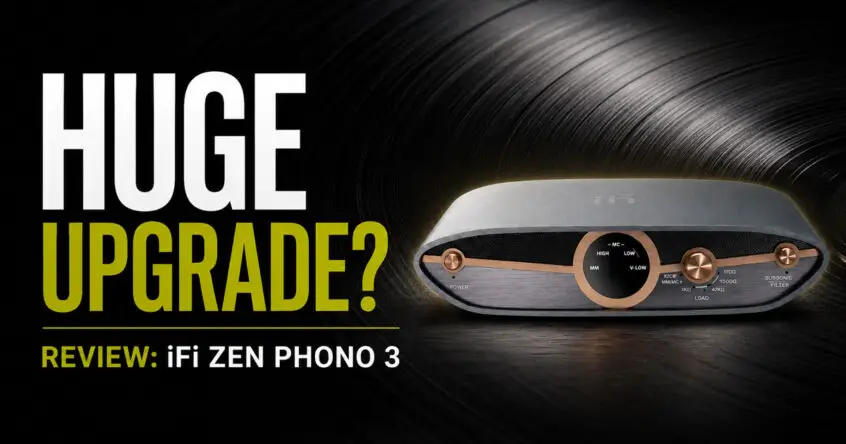
The original iFi ZEN Phono was my living-room phono stage of choice for quite some time.
That should give you a fairly good idea of where I stood on it.
There are plenty of affordable phono preamps that sound decent, but the original ZEN Phono stood out for combining a remarkably low noise floor with accurate RIAA equalisation, adjustable gain and a balanced output—all at a very reasonable price.
More importantly, it sounded excellent.
It was clean, quiet and controlled without becoming thin or clinical. For anyone looking to move beyond the phono stage built into a turntable or amplifier, it was an easy product to recommend.
The iFi ZEN Phono 3 is its replacement, retaining the same general shape and much of the same internal philosophy while adding one particularly important feature: adjustable cartridge loading.
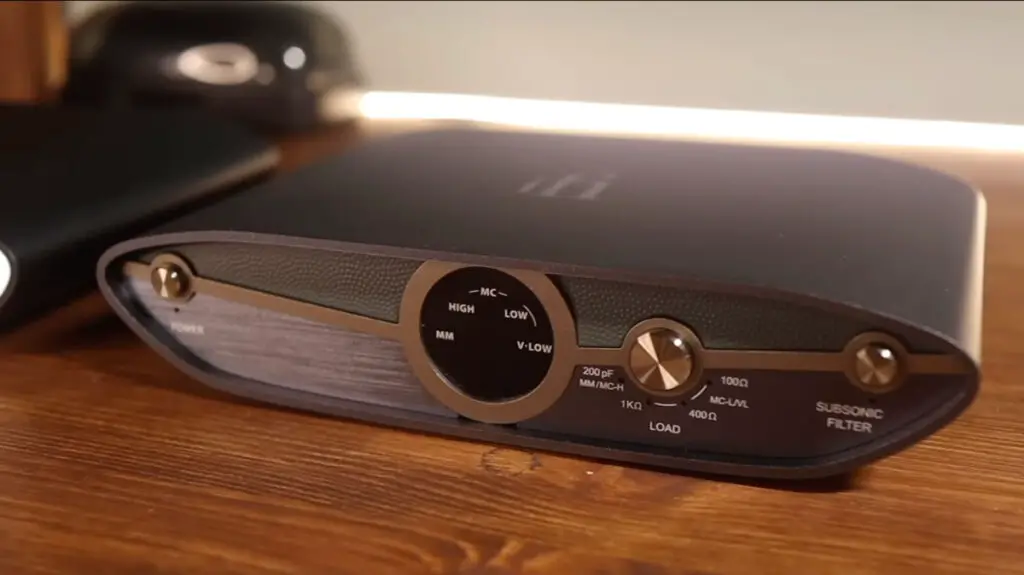
That may not sound especially exciting if you only ever use moving-magnet cartridges. However, for moving-coil users—or anyone who would like a phono preamp capable of growing with their system—it makes the new model considerably more flexible.
The original set a high standard, so the question is whether iFi has genuinely improved it or simply changed a few details and given it a new front panel.
After spending time with the ZEN Phono 3 using both moving-magnet and moving-coil cartridges, I think it remains one of the benchmark phono preamps in its class.
What’s New With the iFi ZEN Phono 3?
The basic shape will be immediately familiar to anyone who has used another product from iFi’s ZEN range.
It retains the distinctive low-profile metal case, with curved edges and a compact footprint that should fit comfortably into most hi-fi systems.
The biggest functional change is the addition of cartridge-loading adjustment on the front panel.
The original ZEN Phono already supported both moving-magnet and moving-coil cartridges, with four gain settings ranging from 36dB to 72dB. The ZEN Phono 3 retains that flexibility, but you now have greater control over the impedance presented to the cartridge.
Cartridge loading can have a noticeable effect on the performance of a moving-coil cartridge. It influences how the cartridge interacts electrically with the phono stage and can affect tonal balance, dynamics and high-frequency behaviour.
The ideal setting will depend on the cartridge manufacturer’s recommendation, the design of your system and, to some degree, your own listening preference.
Moving-magnet cartridges are generally more standardised in this area, typically expecting a 47kΩ input. Moving-coil designs vary much more widely, which is why adjustable loading becomes particularly useful once you start exploring them.
The original ZEN Phono could handle moving-coil cartridges, but the additional loading options make the third-generation model feel like a more complete and adaptable product.
Design and Build Quality
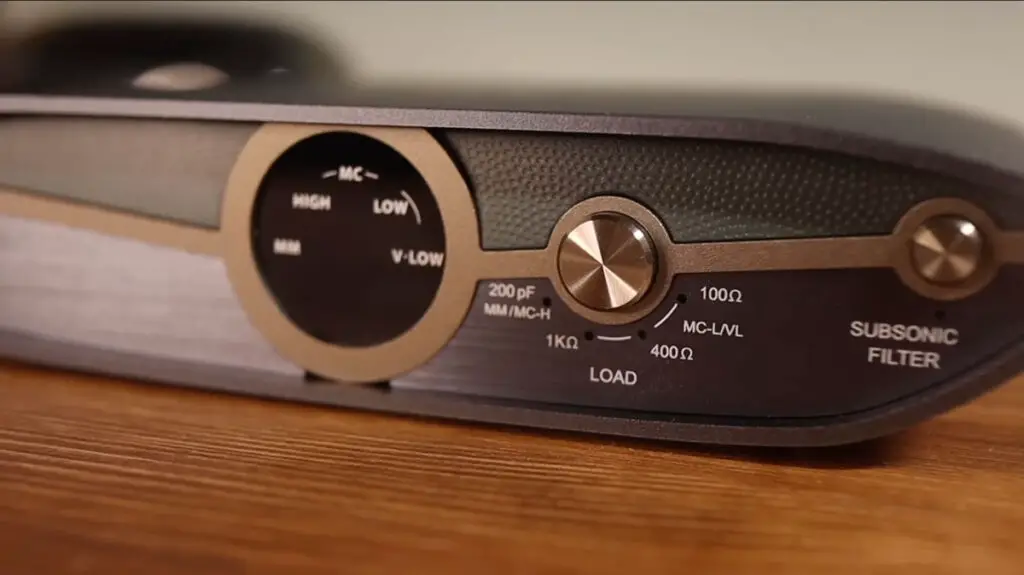
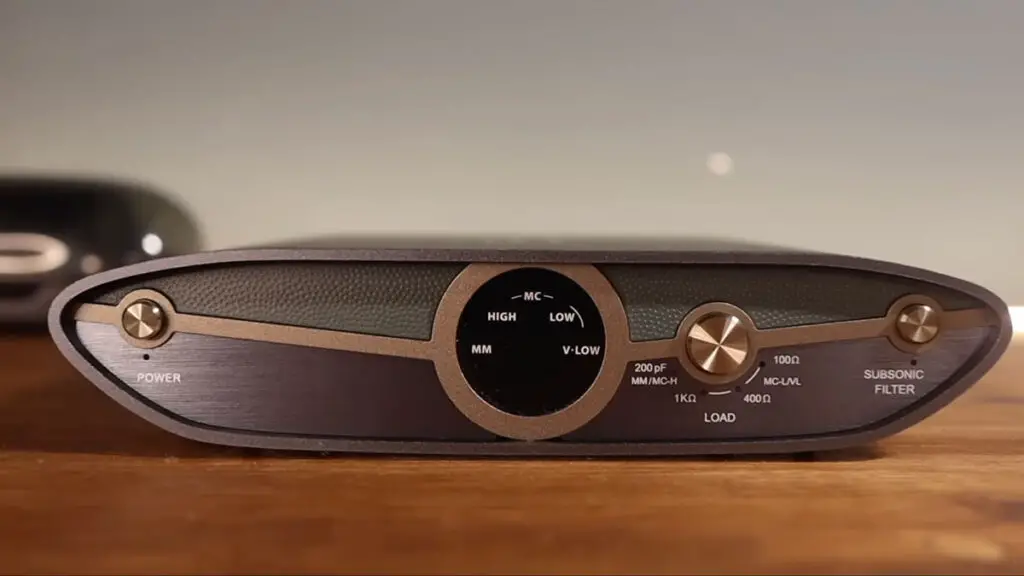
Aesthetically, the ZEN Phono 3 is a little busier than the model it replaces.
The clean brushed-aluminium front of the original has made way for a more involved design, including a darker, almost leather-effect section across the upper half of the panel.
Some people will undoubtedly prefer the cleaner and more minimalist appearance of the previous version.
Personally, I like the new look.
More importantly, I find the indicator lights much easier to read. On the original model, it was not always immediately obvious which gain setting had been selected, particularly if the phono stage was positioned on a lower shelf or viewed from an angle.
The new front panel communicates the settings more clearly.
The controls remain simple. The power button and subsonic filter control sit on the front, alongside the new loading selector and status indicators.
Around the back, things are more familiar.
You get standard RCA inputs and outputs, a grounding post, the gain selection control and iFi’s 4.4mm balanced output.
There is no balanced input, which is hardly surprising at this price, but the ability to run a balanced connection from the phono stage to a compatible amplifier or preamp remains unusual in this part of the market.
The only practical complaint carried over from the original is the power cable.
It is still rather short.
That might sound like a trivial issue, but hi-fi components are often spread across shelves, cabinets and separate power-management arrangements. A little more cable length would make positioning the unit considerably easier.
It was a bugbear of mine with the original ZEN Phono, and unfortunately, it remains one here.

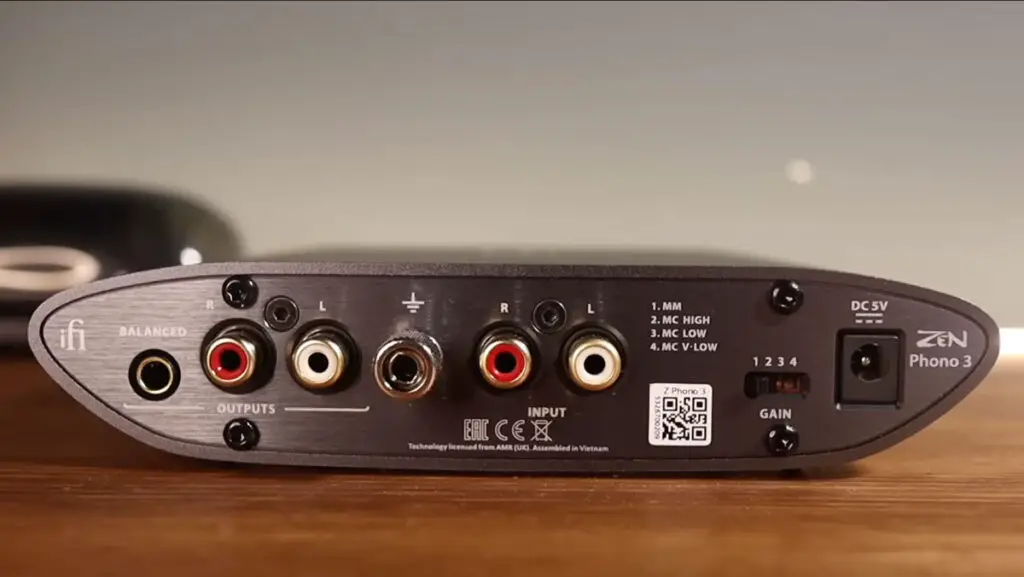
Balanced Output at an Affordable Price
Balanced connections are commonplace in professional audio but remain frustratingly uncommon in consumer hi-fi, particularly at the affordable end of the market.
The main advantage is improved rejection of noise picked up along the cable run.
An unbalanced RCA connection carries the audio signal relative to ground. A balanced connection carries two versions of the signal with opposite polarity. Any interference picked up equally by both conductors can then be cancelled at the receiving end.
This is particularly useful with longer cable runs or in systems containing numerous power supplies, digital devices and other potential sources of electrical interference.
To use the ZEN Phono 3’s balanced output, you will need a suitable 4.4mm cable and a compatible balanced input on your amplifier or preamp.
Not everyone will have the equipment required to take advantage of it, but its inclusion gives the ZEN Phono 3 a feature that very few direct competitors can match.
Even when used through its conventional RCA outputs, though, this remains an exceptionally quiet phono stage.
The Intelligent Subsonic Filter
The ZEN Phono 3 also retains iFi’s intelligent subsonic filter.
A subsonic filter removes extremely low frequencies beneath the useful musical range. These frequencies can be generated by warped records, turntable rumble or other unwanted mechanical movement.
You may notice this as your speaker woofers moving in and out dramatically, even when there appears to be very little audible bass in the music.
That unnecessary movement consumes amplifier power and places additional demands on the speakers. In some systems, it can also make the audible bass sound less controlled.
The problem with a conventional subsonic filter is that it may also remove some genuine low-frequency musical information.
iFi’s approach is based on the way stereo records are cut.
Most musical bass information is recorded largely as lateral groove movement, while strong vertical low-frequency movement is more likely to be caused by a warp or mechanical disturbance.
The filter is designed to distinguish between the two, reducing unwanted subsonic movement without noticeably thinning out the musical bass.

In practice, I found it useful on records with visible warping or systems where woofer movement was becoming distracting. It is not a control I felt the need to leave engaged at all times, but it is a valuable tool to have available.

What Is RIAA Equalisation?
One of the things that impressed me most about the original ZEN Phono was the accuracy of its RIAA equalisation.
If you are relatively new to vinyl, that probably requires some explanation.
When a record is cut, the bass frequencies are reduced dramatically and the treble is boosted.
There are practical reasons for doing this.
Powerful bass would otherwise require much wider grooves, severely limiting how much music could fit onto each side of the record. Reducing the bass during cutting allows the grooves to remain narrower, while boosting the treble helps keep surface noise less intrusive during playback.
Your phono preamp then has to reverse that process.
It boosts the bass and reduces the treble according to a standardised curve established by the Recording Industry Association of America—the RIAA curve.
The more accurately the phono stage performs that reversal, the closer the tonal balance should be to what was intended when the record was mastered.
Poor RIAA accuracy can make a system sound too bright, too dull, too bass-heavy or lacking in weight.
iFi specifies RIAA accuracy within ±0.15dB for the ZEN Phono 3 and attributes this partly to the use of multiple closely matched capacitors within the equalisation circuit.
Manufacturer specifications should always be treated with a degree of caution, but independent measurements of the ZEN Phono 3 show an extremely accurate RIAA response.
That is important because the sound of a phono stage should not be shaped by errors in the equalisation curve.
The goal is to restore the signal correctly and allow the cartridge, record and wider system to determine the character you hear.
Why the Noise Floor Matters
The other headline feature is the ZEN Phono 3’s very low noise floor.
A phono cartridge produces a tiny electrical signal.
A typical moving-magnet cartridge might output only a few millivolts, while a low-output moving-coil design can produce a fraction of that.
The phono stage must amplify this extremely weak signal before it can be passed to the rest of your system. Unfortunately, any noise introduced at this early point is amplified along with the music.
This is why phono-stage noise matters so much.
iFi quotes an Equivalent Input Noise figure as low as -151dBV, although the precise performance depends on the selected gain mode.
Equivalent Input Noise, often shortened to EIN, is a way of expressing how much noise the circuit itself contributes at its input. Broadly speaking, a more negative figure indicates a quieter design.
The technical details are less important than the practical result: the ZEN Phono 3 is exceptionally quiet for a phono stage at this price.
That was one of the standout qualities of the original, and it remains central to the appeal of the new version.
A low noise floor does not simply mean hearing less hiss between tracks.
When the background is cleaner, subtle details become easier to perceive. Quiet passages feel genuinely quiet, reverb tails remain audible for longer and small dynamic changes are not masked by the electronics.
The music has more room to breathe.
Listening Test
For my listening tests, I used the ZEN Phono 3 with two very different cartridges: the Ortofon 2M Blue moving magnet and the Ortofon Quintet Red moving coil.
The overall character remained consistent with both.
This is a clean, controlled and highly capable phono stage for the money.
The low noise floor is the first thing that stands out.
This is not merely a figure that looks impressive on a specification sheet. You can hear the benefit in practice.
Quiet sections remain properly quiet, giving individual sounds a cleaner space from which to emerge.
With more delicate recordings, this helps reveal room ambience, reverb tails, small shifts in dynamics and the texture surrounding vocals and acoustic instruments.
The ZEN Phono 3 does not push those details aggressively towards you. It is not one of those hi-fi products that creates a superficial impression of resolution by exaggerating the upper midrange or treble.
Instead, it steps out of the way.
The details are present because less noise is obscuring them, not because the phono stage is artificially highlighting them.
Tonal Balance
Tonally, I would describe the ZEN Phono 3 as clean and balanced rather than overtly warm or bright.
It does not impose a particularly strong sonic signature, but neither does it sound thin, sterile or uninvolving.
There is enough weight through the midrange for voices and instruments to sound natural, while the upper frequencies feel open and well controlled.
Vocals remain solidly placed, with good clarity around consonants and natural body through the lower midrange.
Acoustic instruments retain their texture without becoming overly sharp or etched.
The presentation is refined, but not excessively polished.
This is important because neutrality is sometimes mistaken for a lack of personality. A phono stage does not have to add obvious warmth or thickness to sound musical.
The ZEN Phono 3 allows the character of the record and cartridge to come through without making the system sound stripped of energy.
That is exactly what I want from a phono preamp.
Bass Performance
Bass is tight, composed and well defined.
It does not exaggerate the low end to create an immediate impression of power. Instead, bass notes start and stop cleanly, allowing rhythm sections to retain their shape and timing.
This is an area where the ZEN Phono 3 differs from the popular Schiit Mani 2.
To my ears, the Mani 2 has a slightly fuller and more coloured low end. Some listeners may prefer that presentation, particularly if their system is already a little lean or they enjoy a warmer overall balance.
Personally, that is not really what I look for in a phono stage.
The ZEN Phono 3 sounds more controlled.
Bass guitars are easier to follow, kick drums remain focused and low-frequency information is less likely to blur into the lower midrange.
It may not sound quite as immediately rich as the Mani 2, but I find it more convincing over longer listening sessions.
Soundstage and Separation
The soundstage is another strength.
There is a good sense of width, with individual instruments occupying clearly defined spaces rather than becoming bunched together around the centre.
The presentation also feels organised.
That may not be the most glamorous way to describe a hi-fi component, but it matters.
When the frequency response is accurate and the background is quiet, it becomes easier to follow different musical elements without the sound becoming clinical or dissected.
Dense arrangements remain intelligible, while simpler recordings benefit from a stronger sense of space.
This is particularly noticeable when comparing the ZEN Phono 3 with the basic stages built into many turntables, powered speakers and integrated amplifiers.
The improvement is not subtle.
You gain more space, better definition, stronger separation and a more confident overall presentation.
It is the kind of upgrade that reminds you how important the phono stage is to the final sound of a vinyl system.
Moving Magnet Versus Moving Coil
With the Ortofon 2M Blue, the ZEN Phono 3 sounded lively, open and controlled.
The 2M Blue is already a detailed and relatively revealing moving-magnet cartridge, and the iFi allowed that character to come through without pushing it towards brightness.
Switching to the Quintet Red demonstrated why the additional flexibility of the ZEN Phono 3 matters.
Moving-coil cartridges generally produce a much lower output and place different electrical demands on the phono stage.
The selectable gain and loading options made it possible to match the iFi more appropriately to the cartridge, while the low noise floor prevented the additional amplification from becoming distracting.
Naturally, cartridge matching still matters. The ZEN Phono 3 cannot make every cartridge work perfectly with every system, and you should always begin with the cartridge manufacturer’s recommended settings.
However, it provides far more scope for experimentation than most phono stages at this price.
That makes it a particularly attractive choice for anyone currently using moving magnet but considering a move to moving coil in the future.
How Does It Compare With the Original ZEN Phono?
The family resemblance is immediately apparent.
The ZEN Phono 3 retains the clean, quiet and composed character that made the original so impressive.
This is not a radical sonic reinvention, nor did it need to be.
The original model was already extremely good.
The main improvement is flexibility.
If you exclusively use conventional moving-magnet cartridges, the adjustable loading may not transform your listening experience. The original ZEN Phono already provided the standard loading required by most MM cartridges and delivered excellent performance.
For moving-coil users, however, the new controls make the ZEN Phono 3 considerably more useful.
They also make it a better long-term purchase.
You can begin with an affordable moving-magnet cartridge, move to a high-output moving coil and eventually experiment with lower-output MC designs without immediately needing to replace the phono stage.
The easier-to-read front panel is another worthwhile improvement, even though some listeners may prefer the cleaner styling of the previous model.
Who Is the iFi ZEN Phono 3 For?
The most obvious customer is someone upgrading from a built-in phono stage.
Many affordable turntables, amplifiers and powered speakers include a phono input, but these circuits are often added primarily for convenience.
They can get a system up and running, but they rarely offer the low noise, headroom, accurate equalisation and spacious presentation of a good external phono preamp.
The ZEN Phono 3 should provide an obvious improvement in most of these systems.
It also makes sense for anyone who wants to experiment with different cartridges without repeatedly replacing other components.
The combination of adjustable gain, cartridge loading, moving-magnet and moving-coil support, balanced output and intelligent subsonic filtering is unusually comprehensive at this price.
Owners of the original ZEN Phono face a slightly more difficult decision.
For moving-magnet users who are already happy with the original, this is not necessarily an essential upgrade.
If you use moving coil, plan to move into moving coil or simply want greater control over cartridge matching, the ZEN Phono 3 becomes much more compelling.
Pros and Cons
Pros
- Exceptionally low noise
- Accurate RIAA equalisation
- Clean, balanced and controlled sound
- Supports moving-magnet and moving-coil cartridges
- Four gain settings
- Adjustable cartridge loading
- Useful intelligent subsonic filter
- 4.4mm balanced output
- Strong soundstage and separation
- Excellent value for the performance and features
Cons
- The new styling may divide opinion
- Loading options may be unnecessary for MM-only systems
- Power cable is still frustratingly short
- Owners of the original may not need to upgrade unless they require the added flexibility
Sound Matters Verdict
The iFi ZEN Phono 3 is a very strong follow-up to one of my favourite affordable phono stages.
The original ZEN Phono combined excellent measured performance with a genuinely quiet, clean and enjoyable sound. The new version keeps that foundation intact while adding flexibility where it matters most.
Cartridge loading is the major upgrade.
If you only ever intend to use moving-magnet cartridges, it may not feel revolutionary. But for moving-coil users—or anyone who wants the freedom to explore different cartridges in the future—it makes the ZEN Phono 3 a more complete product.
You still get the features that made the original so compelling: very low noise, accurate RIAA equalisation, adjustable gain, balanced output and the intelligent subsonic filter.
More importantly, it still sounds excellent.
It is not trying to impress by exaggerating the bass, sharpening the treble or making every record sound artificially dramatic.
Instead, it provides a clean, accurate and low-noise platform that allows the cartridge and records to do the talking.
The short power cable remains irritating, and I can understand why some listeners will prefer the simpler appearance of the previous model.
But these are minor complaints when set against the performance and feature set.
For anyone moving away from a built-in phono stage, the ZEN Phono 3 is likely to feel like a major upgrade. It delivers more space, better definition, lower noise and a considerably more refined presentation.
For someone looking for one affordable phono preamp that can grow with their system—from moving magnet into moving coil—it is one of the most compelling options I have tested.
The original ZEN Phono was easy to recommend, and the ZEN Phono 3 continues that tradition.
It is quiet, accurate, flexible and genuinely good value.
For me, this remains one of the benchmark phono preamps in its class.
VIEW PRODUCT ON AMAZON
