
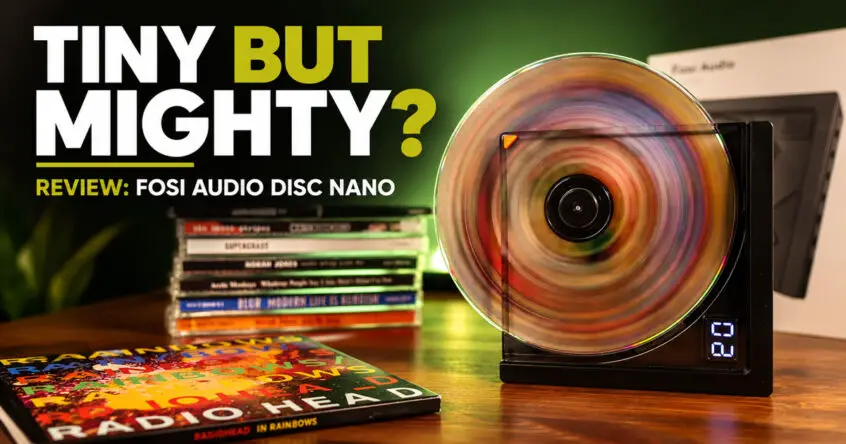
Just the other week, I reviewed the Fosi Audio Merak CD player, and I came away rather impressed. It was compact, affordable, sounded good, and offered a surprisingly flexible way to get back into listening to CDs.
There was one thing missing, though: a built-in battery.
The Merak is a lovely little desktop solution, but it’s hardly something you’d take out for a walk.
Then, just a few days after my review went live, Fosi Audio released something completely different.
Meet the Fosi Audio DISC Nano, an extraordinarily compact portable CD player with a rather unusual design.
And I’ve got to admit, when I first saw it, I wasn’t entirely sure what to make of it.
Was this simply another novelty product designed to cash in on the growing appetite for retro technology? Or could it actually be a genuinely useful portable CD player?
I’ve been spending the last couple of weeks finding out, and I’ve ended up enjoying this little gadget rather more than I expected.
What Is the Fosi Audio DISC Nano?
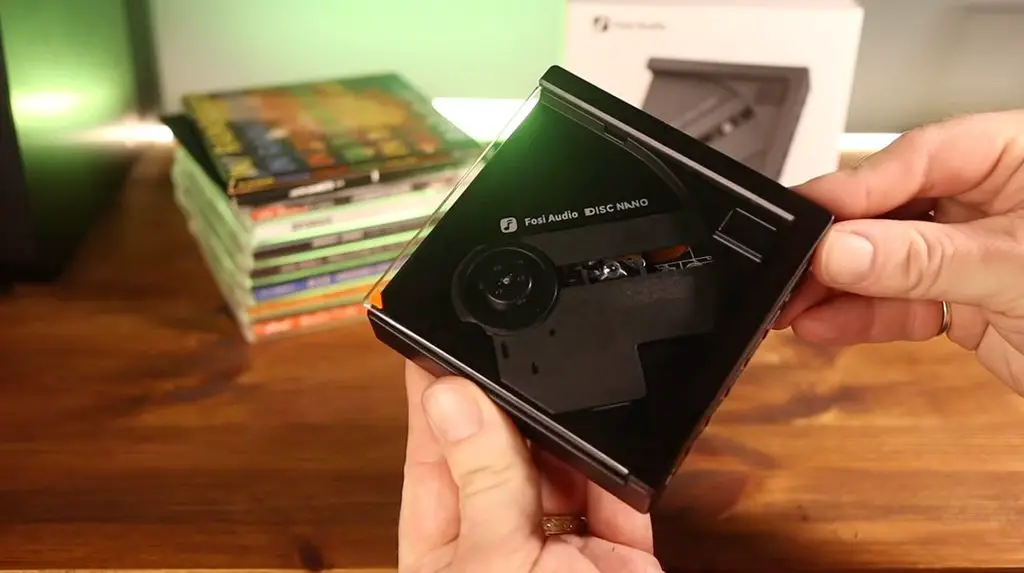
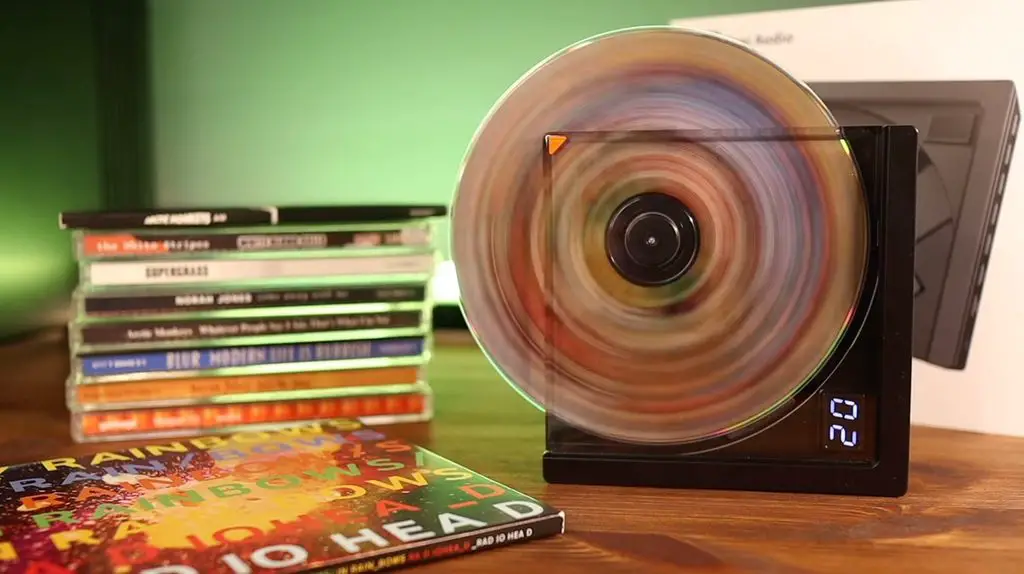
The DISC Nano is a miniature portable CD player with an unusual half-exposed disc mechanism. Rather than enclosing your CD within a conventional circular body, Fosi has designed a device that’s actually smaller than the disc itself.
The player measures just 102 × 102 × 29mm and weighs around 210g, making it small enough to slip into a coat pocket or everyday bag.
Unlike the Merak, the Nano also has a built-in 800mAh rechargeable battery, with USB-C charging and an advertised listening time of around two hours.
And despite its tiny dimensions, there’s a surprising amount of technology packed inside.
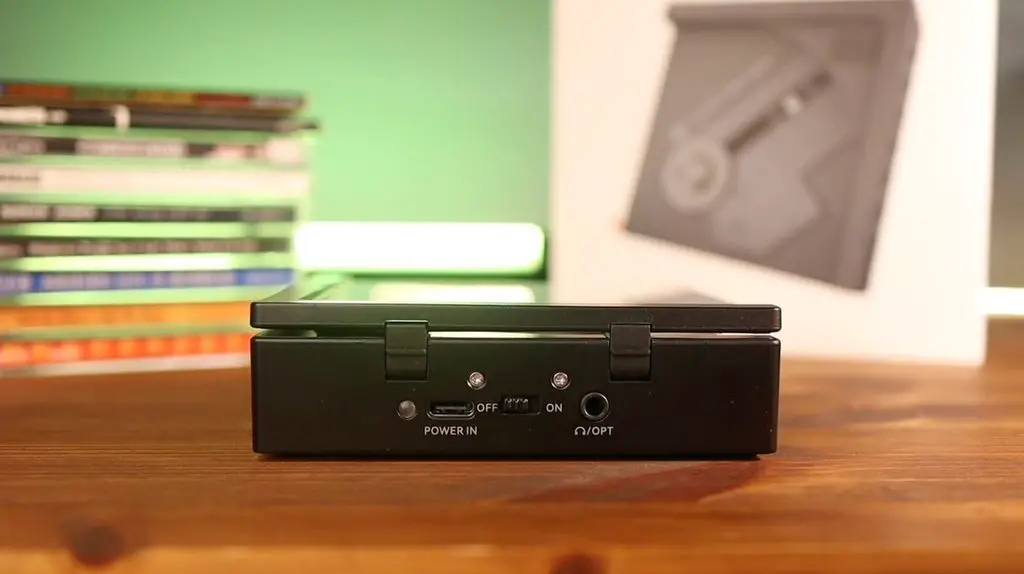
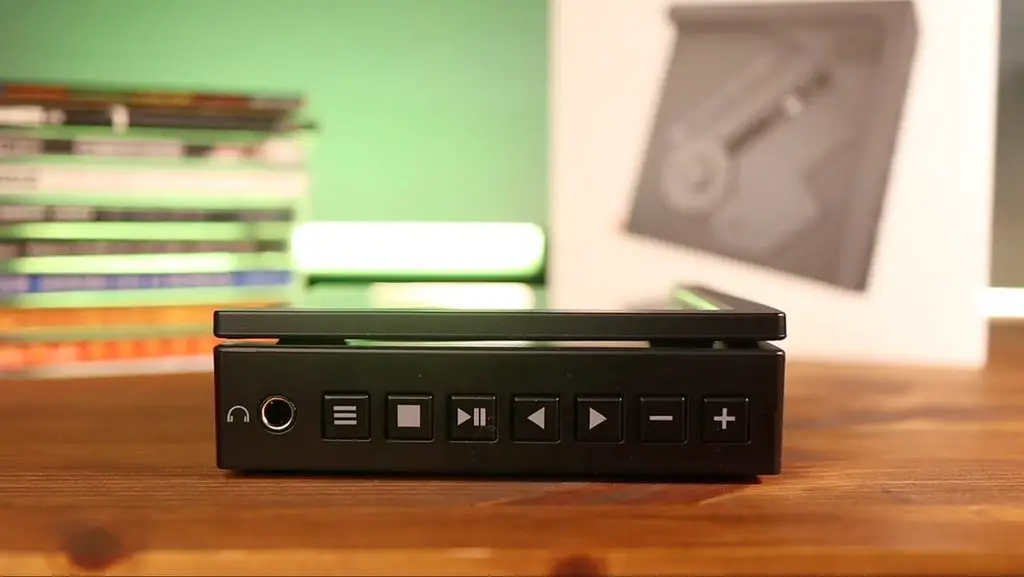
The Nano features a Cirrus Logic CS43198 DAC, a conventional 3.5mm headphone output that doubles as an optical digital connection, and a separate 4.4mm balanced headphone output for compatible headphones.
There’s also Bluetooth connectivity, allowing you to send music wirelessly from your CD to compatible headphones or speakers.
Naturally, for something designed to be portable, Fosi has included electronic skip protection (ESP), which helps prevent playback interruptions caused by movement or vibration.
So despite its distinctly retro appearance, this isn’t simply an old-fashioned Discman in miniature.
It’s a modern little audio device that happens to play physical CDs.
And at around $99.99, it’s not going to break the bank either.
A Design Influence Straight Out of the 1980s
If you’ve been around portable audio equipment for a while, the Nano’s unusual design might look rather familiar.
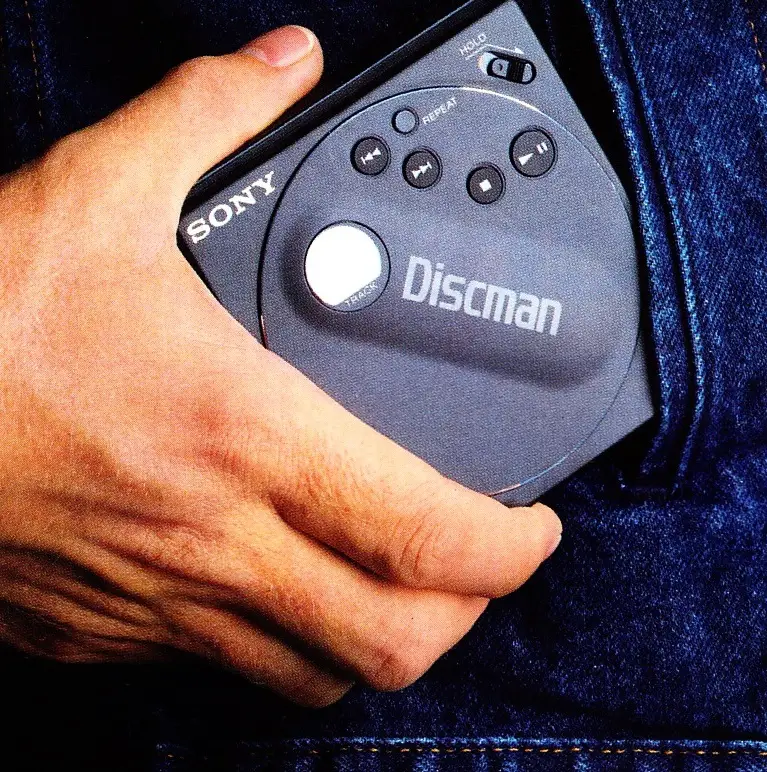
That’s because it bears more than a passing resemblance to Sony’s D-88 Discman, originally introduced in 1988.
The D-88 was an incredibly small portable CD player designed primarily around the 8cm mini CD format.
But here’s the clever part.
Sony also allowed it to play standard 12cm CDs, despite the player itself being considerably smaller than a conventional disc.
To achieve this, part of the CD remained exposed outside the body of the player.
It was an unusual solution, to say the least, but it made the D-88 a fascinating piece of portable technology.
The model was relatively short-lived, with production ending around 1990, but it has remained highly collectible among vintage audio enthusiasts.
Fast-forward to 2026, and Fosi Audio has taken a remarkably similar approach with the DISC Nano.
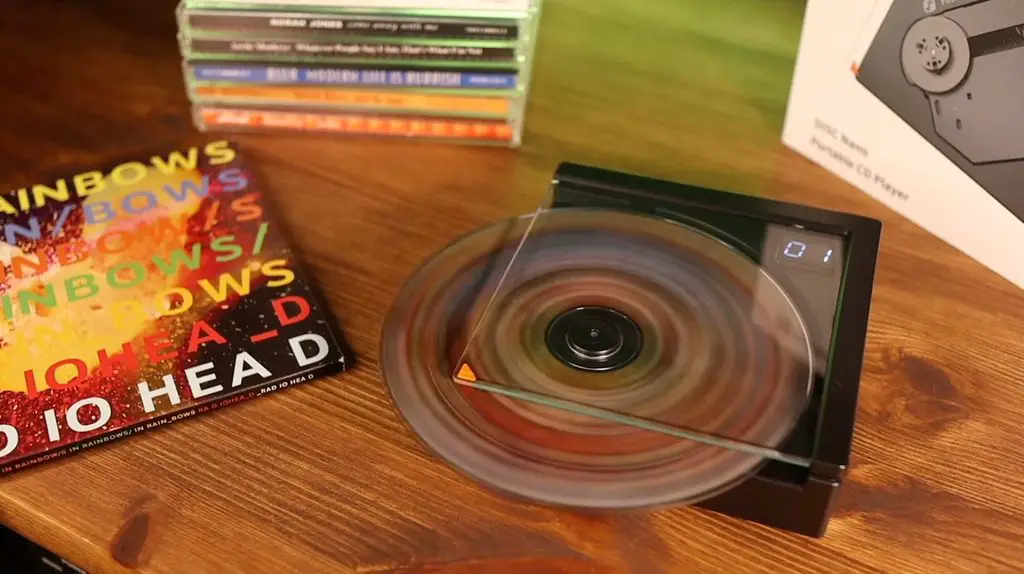
The disc sits on a locking spindle, with a substantial portion remaining exposed as it spins.
And I’ve got to say, there’s something rather appealing about it.
When I was younger, I generally preferred conventional tray-loading CD players. But these days, with so much music listening happening through screens and invisible digital files, I find it strangely satisfying to actually see the disc spinning.
It’s one of those little things that makes physical music more enjoyable.

Of course, there’s a fairly obvious drawback.
Having a CD protruding from the player isn’t exactly the most reassuring arrangement when you’re moving around.
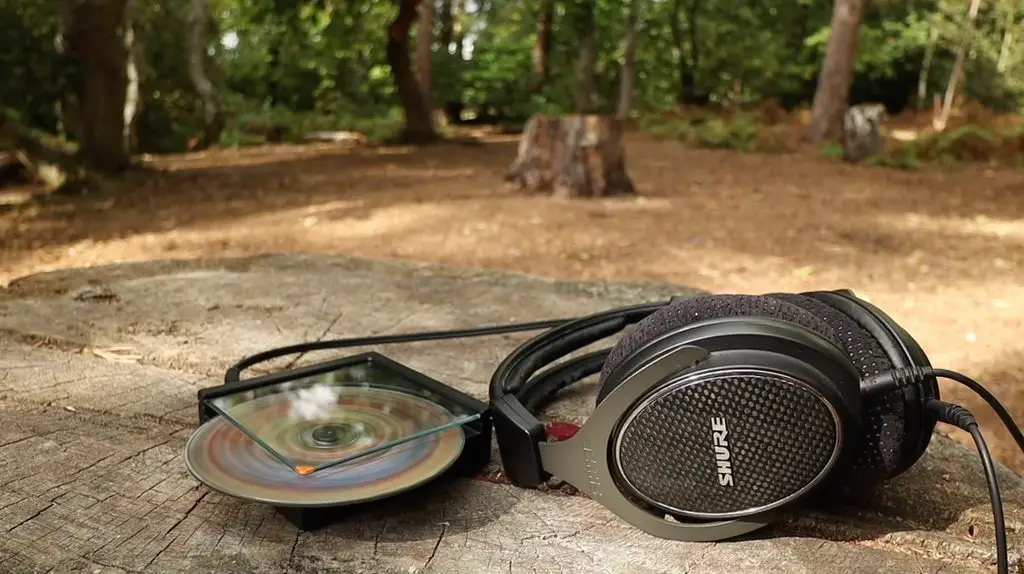
It feels much more comfortable sitting on a desk or table, where you’re unlikely to accidentally knock the disc.
And while the locking mechanism holds the CD in place, I’d certainly be more cautious using this than a conventional portable CD player with a fully enclosed lid.
Still, as a piece of design, I think it’s brilliant fun.
Why Release a Portable CD Player Like This in 2026?
Now, you might reasonably wonder why anyone would want a miniature CD player in an age when practically everyone carries a smartphone capable of accessing millions of songs.
It’s a fair question.
But I think the answer goes beyond CDs themselves.
Just the other day, I was browsing an antique shop when I noticed two very young guys looking at a collection of vintage cameras.
They seemed absolutely mesmerised by them.
And it got me thinking about the wider resurgence of interest in older technology.
Whether we’re talking about vinyl records, cassette players, analogue cameras, or even old digital cameras from the 2000s, there’s clearly an appetite for technology that feels a little more tangible and distinctive.
And interestingly, a lot of that enthusiasm appears to be coming from younger generations.
CDs are making a comeback
According to Luminate’s 2026 midyear report, CD sales in the United States increased by 16% during the first half of the year, reaching 16.3 million units.
Now, K-pop accounted for a substantial amount of that growth, but even when those sales were excluded, CDs were still up by 6.7%.

That’s a pretty impressive turnaround for a format that many people had written off.
Meanwhile, research published by Aviva found that 24% of UK adults surveyed own a vinyl record player.
And it’s not just older generations holding onto their equipment. Some 18% of Gen Z respondents and 16% of Millennials also reported owning a turntable.
The same research highlighted continued interest in other retro-style gadgets, including analogue and Polaroid cameras.
What’s particularly interesting, though, is another finding from Luminate suggesting that approximately half of Gen Z and Millennial CD buyers don’t actually own a CD player.
In other words, people are buying physical music again, but not necessarily listening to it on the original format.
Some are buying CDs as collectibles. Others want to support their favourite artists, or simply appreciate having something physical to own.
And I think that’s precisely where products like the DISC Nano start to make sense.
For one thing, they provide an affordable way for people to actually play the CDs they’re collecting.
But perhaps just as importantly, the Nano is simply a cool little gadget.
It combines the nostalgia and visual appeal of vintage technology with some genuinely useful modern conveniences.
And that’s a combination I can see appealing to younger music fans just as much as those of us who remember the original Discman era.
Modern Hi-Fi Technology in a Tiny Package
What makes the DISC Nano particularly interesting is that Fosi hasn’t relied entirely on nostalgia.
Underneath that unusual exterior, there’s some respectable audio hardware.
The built-in Cirrus Logic CS43198 DAC is a welcome inclusion at this price, and the option to connect an external DAC through the optical output gives the player a little more flexibility than you might expect.
So if you already own a desktop DAC or a hi-fi system with optical inputs, you could potentially use the Nano as an extremely compact CD transport.
There’s also that 4.4mm balanced headphone connection, which is something I certainly wouldn’t have expected to find on a miniature portable CD player.
Of course, none of this automatically makes the Nano a high-end audio component.
And I’m not going to pretend that a device costing around $100 is suddenly going to replace a sophisticated dedicated CD transport.
But it does demonstrate that Fosi has tried to make something with genuine audio credentials, rather than simply producing a miniature retro curiosity.
The Bluetooth connectivity is another nice touch.
Personally, I like using wired headphones with a device like this, but being able to send CD audio to Bluetooth headphones or speakers makes it easier to incorporate the Nano into a modern listening setup.
It’s an interesting combination of old and new.
Living With the Fosi DISC Nano
Specifications are all well and good, but I was particularly interested in how the Nano would fit into everyday life.
So, for the past couple of weeks, I’ve made a point of taking it with me wherever I reasonably could.
I’ve used it while working at my desk, listening to music in the living room, and even while walking around my local park.
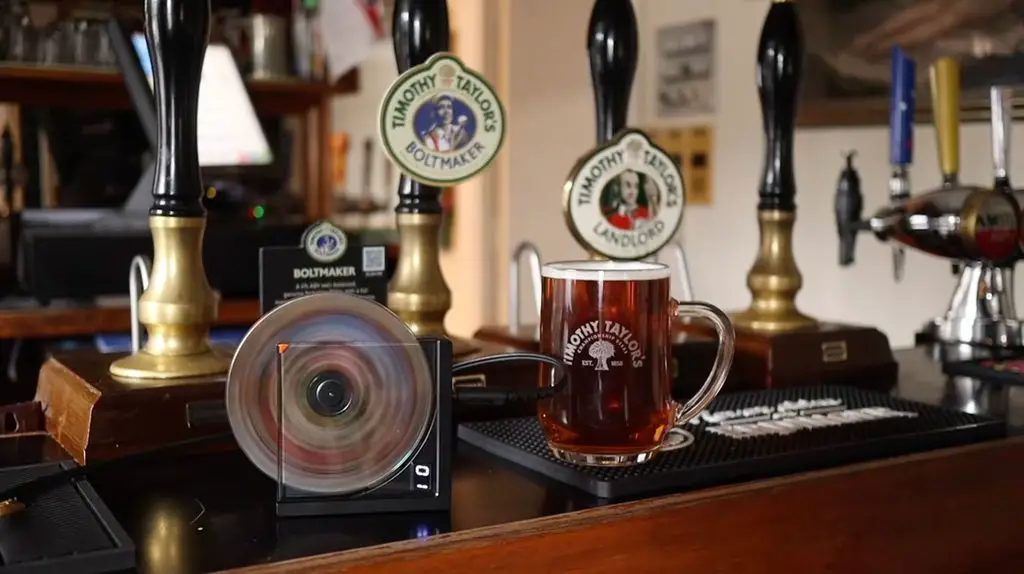
And yes, I also took it to my local pub.
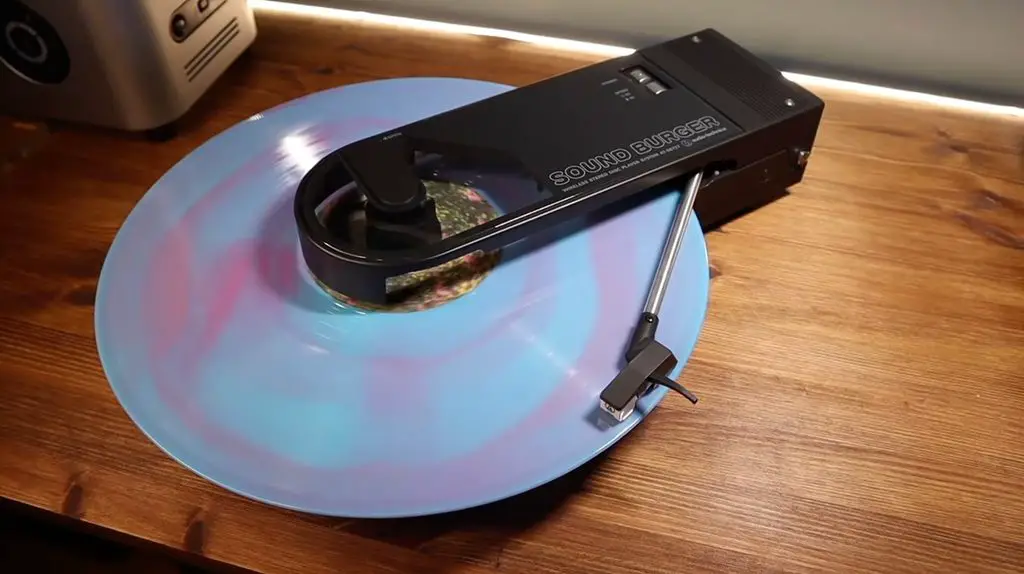
I did something similar with the Audio-Technica Sound Burger a few months ago, largely because I thought it would be amusing to take a miniature portable record player down the pub.
Perhaps not the most conventional way of evaluating audio equipment, but there you go.
And in some respects, I think the DISC Nano shares quite a lot with the Sound Burger.
Both products draw heavily on retro design. Both make physical music feel a little more playful. And both are the sort of devices that can spark a conversation simply because they look so unusual.
But there’s an important difference.
More practical than the Sound Burger?
I’ve always had a soft spot for the Sound Burger.
It’s great fun, it’s an interesting talking point, and I think it’s a lovely product for somebody who wants to experience vinyl in a slightly different way.
But I’ve also tended to see it more as a lifestyle product than a serious portable hi-fi solution.
The DISC Nano, on the other hand, strikes a rather better balance between novelty and practicality.
It’s much easier to imagine taking a small CD player and a pair of headphones out for the day than trying to carry a portable turntable and a selection of vinyl records around.
And, perhaps more importantly, the Nano actually has a decent selection of audio connections and a capable internal DAC.
That’s not to say the exposed-disc design doesn’t create limitations. It certainly does.
But as a device that lets you enjoy physical music away from your normal listening setup, it feels more practical overall.
And I think that’s quite an achievement considering how unusual it looks.
Sound Quality: Better Than a Novelty Product Has Any Right to Be
I’ve been pleasantly surprised by the DISC Nano’s sound quality.
For most of my listening, I used the internal DAC, which is really how I think a portable device like this is intended to be enjoyed.
After all, there’s not much point in buying something so compact if you immediately need to carry around additional equipment just to get a decent listening experience.
And fortunately, I didn’t feel any need to do that.
The Nano sounded very good to my ears, particularly considering its modest price.
I could squeeze a little extra performance out of it using an external DAC, but for the most part I was perfectly happy listening through its own circuitry.
And that’s really what impressed me.
The DISC Nano isn’t just a cool-looking miniature CD player. It’s a genuinely enjoyable way to listen to music.
That distinction matters to me because there are plenty of novelty audio products that are great fun for a few minutes but quickly lose their appeal once you start using them properly.
With the Nano, I found myself continuing to use it simply because I enjoyed the experience.
And that’s perhaps the strongest compliment I can give it.
The MagSafe-Compatible Design Is an Interesting Addition
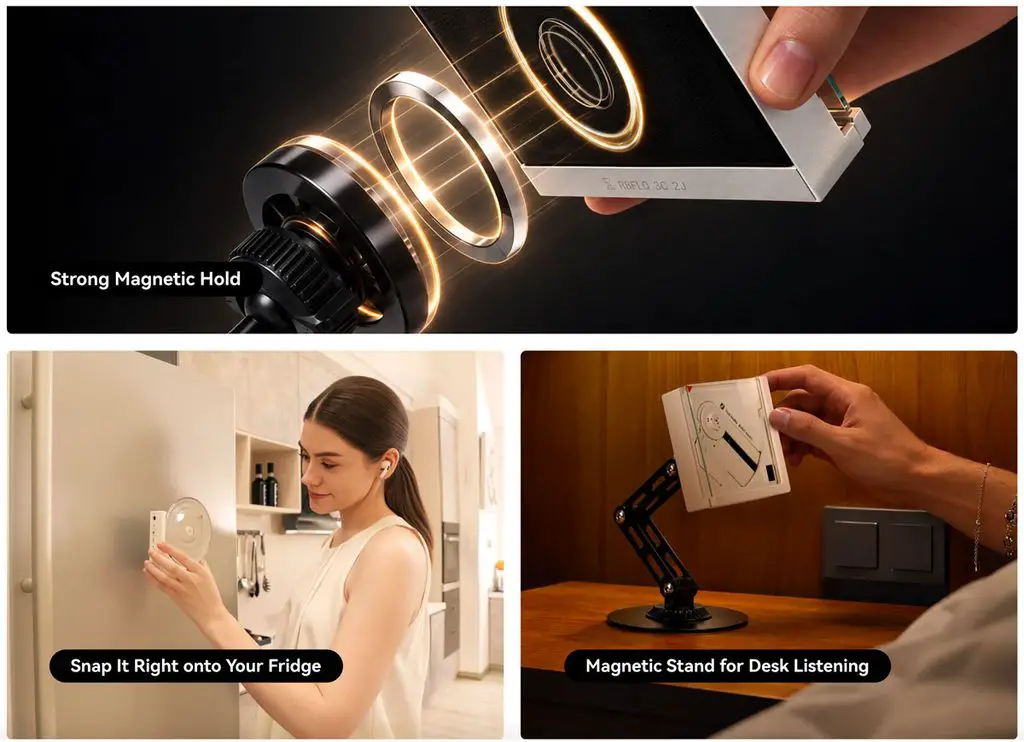
One feature I didn’t expect to find on a portable CD player was MagSafe compatibility.
Now, before anyone gets too excited, this doesn’t mean you can charge the Nano wirelessly.
The feature is purely for magnetic mounting.
Fosi has incorporated a magnetic ring into the design, allowing the player to attach to compatible magnetic stands and surfaces.
So, for example, you could mount it on a suitable desk stand rather than leaving it sitting flat.
Fosi even suggests attaching it to your fridge so you can listen to music while cooking.
I must admit, that’s not something I’d previously considered doing with a CD player.
But I suppose why not?
It’s another example of Fosi thinking a little differently about how people might want to use a physical music player.
For me, the most practical application would probably be a compact desktop setup, particularly where space is limited.
Still, it’s a nice feature to have, and it adds to the Nano’s quirky personality.
Is the DISC Nano Really Portable?
This is where I think we need to be realistic.
Yes, the Nano is impressively small.
Yes, it has a built-in battery.
And yes, the ESP system helps prevent interruptions when you’re moving around.
But the exposed disc means this isn’t quite the sort of rugged portable player you could throw into a backpack and forget about.
You need to be a little more careful.
Personally, I’d like to see Fosi offer some sort of protective pouch for the Nano.
As far as I could tell during my review, there wasn’t a dedicated one available.
And it wouldn’t need to be anything particularly elaborate. Even a simple drawstring pouch would help protect the mechanism from dust and lint when transporting the player without a disc fitted.
Because while I love the exposed-disc aesthetic, the last thing I’d want is to damage the laser mechanism by carrying it around unprotected.
The battery life is another consideration.
With approximately two hours of listening available per charge, depending on how you’re using it, the Nano is more suited to relatively short listening sessions than a full day of travelling.
Personally, I found the battery life reasonable considering the tiny dimensions.
But if you’re planning a long train journey or spending hours away from a power source, you’ll need to bear that limitation in mind.
Fosi DISC Nano vs Merak: Which Should You Buy?
Having reviewed both players recently, I think they serve slightly different purposes.
The Merak makes more sense if you want an affordable, compact CD player that will spend most of its life on a desk or connected to your hi-fi system.
It’s a straightforward solution for people looking to bring CDs back into their everyday listening routine.
The DISC Nano, meanwhile, is all about flexibility and portability.
It’s smaller, has its own battery, and offers a more unusual visual experience.
It’s also a product you’re perhaps more likely to pick up and take somewhere simply because you can.
If I were building a permanent CD listening setup, I’d probably still lean towards the Merak.
But if I wanted something to enjoy CDs around the house, take on an occasional trip or simply have fun with, I’d be very tempted by the Nano.
And given its combination of modern features and compact design, it’s an interesting little alternative.
Final Verdict: Should You Buy the Fosi Audio DISC Nano?
I’ve thoroughly enjoyed spending time with the Fosi DISC Nano.
It’s fun, compact, affordable and, most importantly, it sounds very good for the money.
I particularly appreciate that Fosi hasn’t treated the retro design as an excuse to compromise entirely on the audio side of things.
The inclusion of a capable internal DAC, optical connectivity, Bluetooth transmission and a balanced headphone output gives the Nano considerably more flexibility than you might initially expect.
Of course, it’s not perfect.
The exposed disc requires more care than a conventional portable CD player, and the battery life isn’t going to satisfy somebody who wants to spend an entire day listening away from home.
I’d also really like Fosi to introduce some sort of protective carrying pouch.
But these are compromises I can live with.
And for me, there’s a broader appeal to products like this that goes beyond the hardware.
As streaming services become increasingly embedded in our everyday lives, I find myself appreciating the opportunity to unplug a little more often.
Sometimes that means leaving my phone at home.
Other times, it simply means putting it out of sight and spending some time enjoying an album without notifications, messages or the temptation to check something online.
Now, I’m not suggesting the DISC Nano is going to replace my Tidal subscription and smartphone for everyday portable music listening.
That would be rather unrealistic.
But do I see myself occasionally grabbing the Nano, a pair of headphones and a favourite CD before heading out for a train journey or a low-tech afternoon away from screens?
Absolutely.
And I think that sums up why I like it so much.
The Fosi DISC Nano is a fun, affordable way to rediscover physical music, but it also has just enough genuine hi-fi capability to make it more than a novelty gadget.
For beginners, CD collectors, or anyone with a soft spot for unusual audio technology, it’s well worth considering.
